

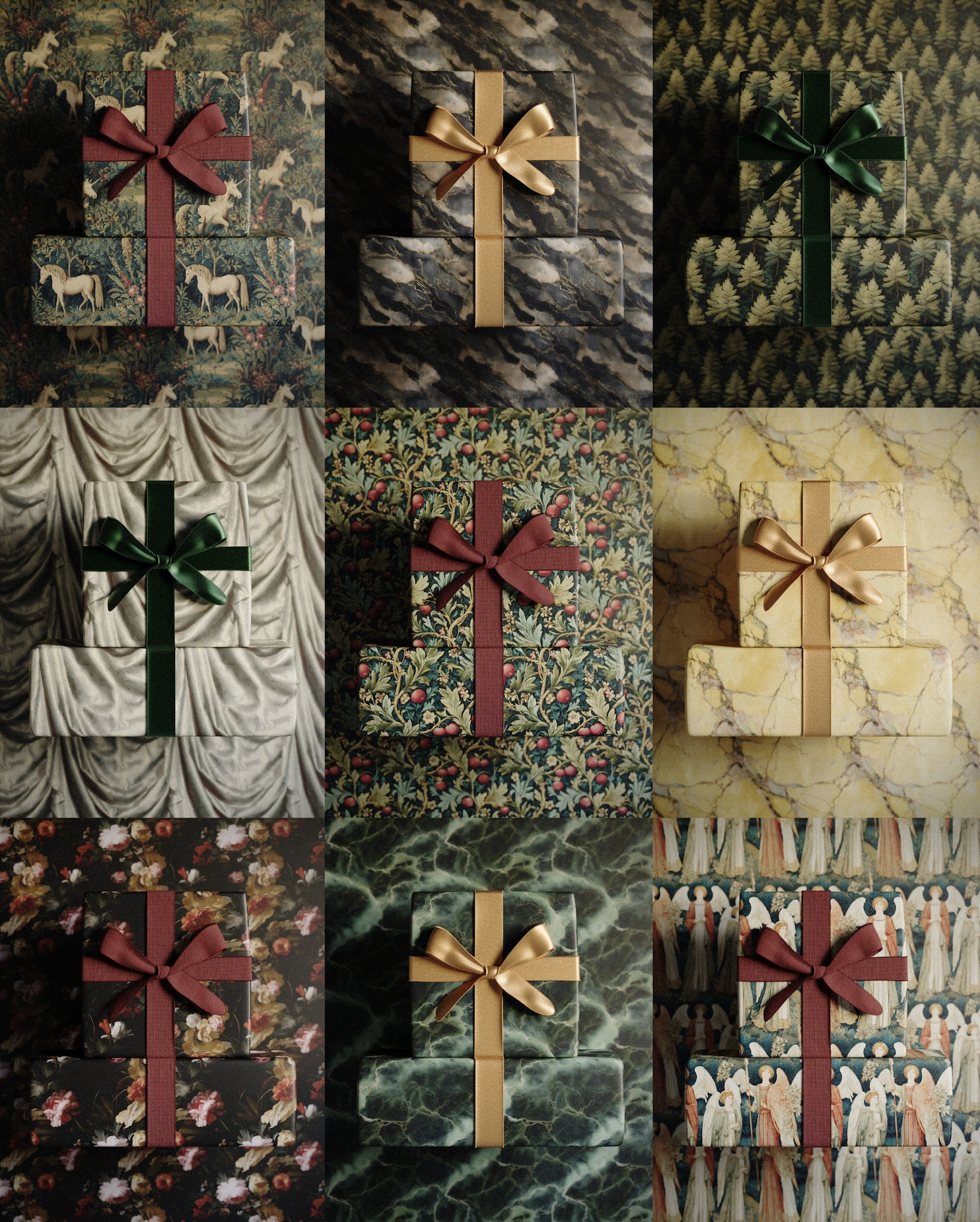
The gift wrap industry has a waste problem. Americans discard approximately 4 million tons of wrapping paper and shopping bags annually, much of it laminated, glittered, or otherwise unrecyclable. Lemieux et Cie‘s “The Art of the Gift” collection offers a counterproposal: Christmas gift wrapping paper designed to be kept, not trashed.
The concept isn’t new, it’s ancient. Japanese furoshiki and Korean bojagi fabric wraps have sustained gift-giving rituals for centuries, transforming presentation into reusable art. Paper eventually democratized decorative wrapping (modern gift wrap debuted accidentally in 1917 when Hall Brothers substituted envelope liners for tissue paper), but it also introduced disposability.
Lemieux et Cie’s solution threads the needle between beauty and responsibility. Each design in the collection draws from art historical sources: Byzantine icons, Florentine hand-painted papers, medieval tapestries, Renaissance angels, Arts and Crafts motifs, baroque damask—printed with enough archival quality that the high- quality wrapping paper functions as frameable art. The idea: if aesthetic wrapping paper is beautiful enough, people won’t discard it.
The production model matters equally. For two decades, Lemieux et Cie has refined a closed-loop approach: water-free digital printing with non-hazardous, vegan inks; on-demand manufacturing that eliminates overproduction and warehousing; and drop-shipping from makers to customers, reducing transportation emissions. The designer wrapping paper meets leading environmental and human-health standards without compromising color saturation or material hand. Perfect? No. Progressive? Measurably. The company audits and iterates across every production country, investing in better chemistry and energy-saving fixation with each collection cycle.
The broader insight echoes across sustainable design: sometimes the most radical innovation looks backward. Those cloth-wrapping traditions that predate consumerism now offer the template for post-consumer responsibility. Premium wrapping paper doesn’t have to be disposable—it just has to be worth keeping.
As Lemieux et Cie frames it: “Beauty shouldn’t cost the earth.” This season, finally, it doesn’t have to.
Get gorgeous projects via email
