

When a client tells her designer “I want to live as if inside The Color of Pomegranates,” she is not asking for decoration — she is asking for transformation. That is exactly what Anastasia Fedorovskaya, founder of Moscow-based studio ANFEDO, delivered in this completed 2025 apartment project: a 115 m² residence in Moscow that breathes the spirit of Sergei Parajanov’s iconic 1969 Armenian film, translated into the texture of everyday living.
A Brief Rooted in Cinema
The client — head of PR at an arts newspaper — is also a passionate collector of books and art. Her brief to Anastasia Fedorovskaya was cinematic and precise: she wanted to inhabit a space that recalled the visual language of Parajanov’s film, with its ethnic motifs, refined lines, and bold interplay of color. Fedorovskaya accepted this challenge and built an interior vocabulary from it, weaving nuanced reds and greens, tactile surfaces, and carefully curated vintage pieces into the rhythms of family life.
The result is not a set piece or a literal recreation of filmic imagery. It is a lived-in home that carries the emotional register of the film — rich, layered, and deeply personal — while remaining entirely functional for a couple, their corgi, and their growing collections.
The Kitchen: Warmth, Function, and Artisanal Craft
 Pin
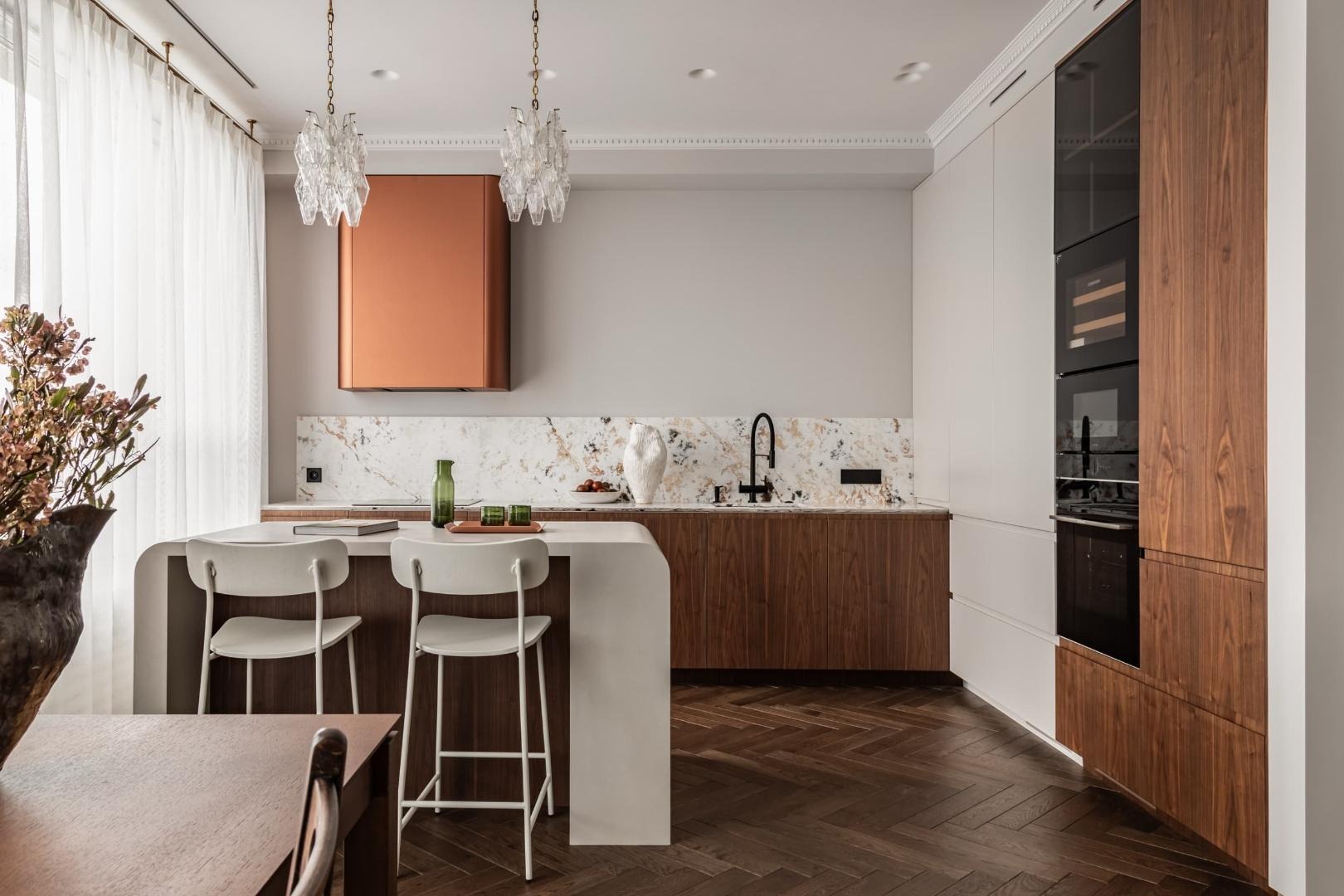
PinThe kitchen showcases a striking copper range hood that immediately draws the eye, anchoring the space with warmth and sculptural presence. The rich walnut cabinetry below is paired with a dramatic marble backsplash featuring rust and cream veining — a material palette that echoes the pomegranate tones running throughout the apartment. A bespoke white island with integrated bar stools provides a social focal point while housing thoughtful custom details, including fitted bowls for the clients’ corgi. The pair of vintage-style faceted crystal chandeliers above add a touch of old-world elegance that bridges the modern and the heirloom.
The kitchen is a masterclass in blending utility with artistry. Anastasia Fedorovskaya chose a copper-finish range hood as the room’s centerpiece — a bold material choice that references the warm metallics of Parajanov’s visual world. The floor is laid in a dark herringbone parquet pattern, grounding the space with a sense of classical European craft, while the marble backsplash introduces organic movement through its complex veining.
Every element is considered at a human scale. The custom kitchen island was not only designed for entertaining but also engineered to accommodate the family’s corgi — a testament to Fedorovskaya’s commitment to functional bespoke design that serves real life, not just aesthetics.
The Living Room: Eclecticism as a Design Philosophy
 Pin
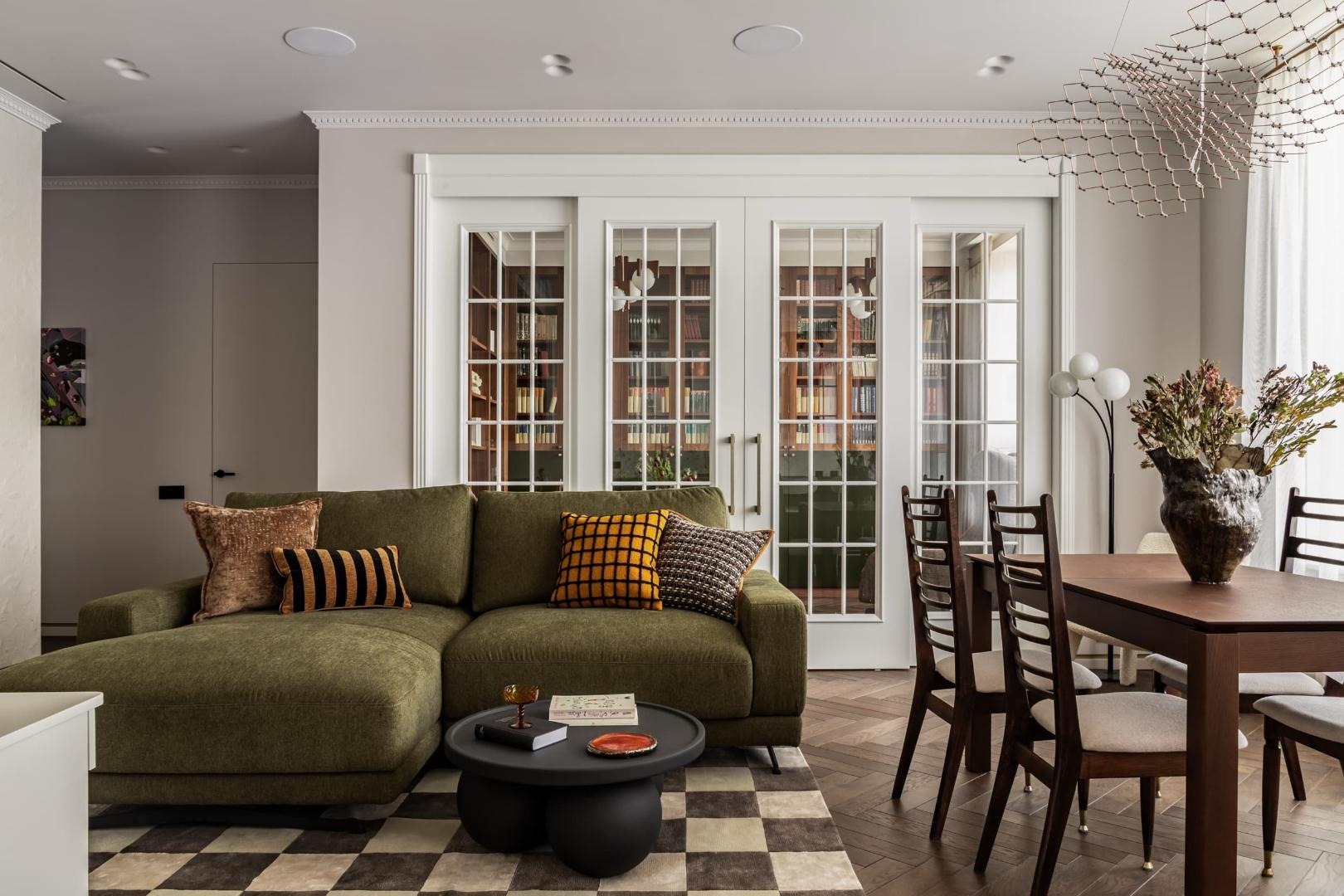
PinThe living room presents a confident, eclectic sensibility: a deep olive-green sectional sofa anchors the space, while an elaborate sculptural chandelier — resembling a kinetic art installation — hovers overhead. Behind the sofa, a wall of glass-paneled French doors reveals a walnut-shelved library, creating a sense of depth and intellectual richness. The checkerboard rug underfoot, mixing warm tones of terracotta and taupe, adds a graphic rhythm to the space that feels both contemporary and vintage. A dark wood dining table and mid-century chairs frame the room on one side, completing an interior that feels curated rather than decorated.
The main living area is where the apartment’s eclectic character asserts itself most fully. Fedorovskaya placed the olive-green sectional as a grounding anchor — a color that directly references the deep, saturated greens in Parajanov’s film. Against the backdrop of classical crown molding and white walls, this choice creates a productive tension between old and new, between restraint and exuberance.
The glass-paneled French doors leading to the library are more than a functional partition — they are a design gesture that speaks to the client’s identity as a collector and reader. Books become a visible backdrop to daily life, framed like artwork within the gridded panes.
The Library: An Intimate Sanctuary of Knowledge
 Pin
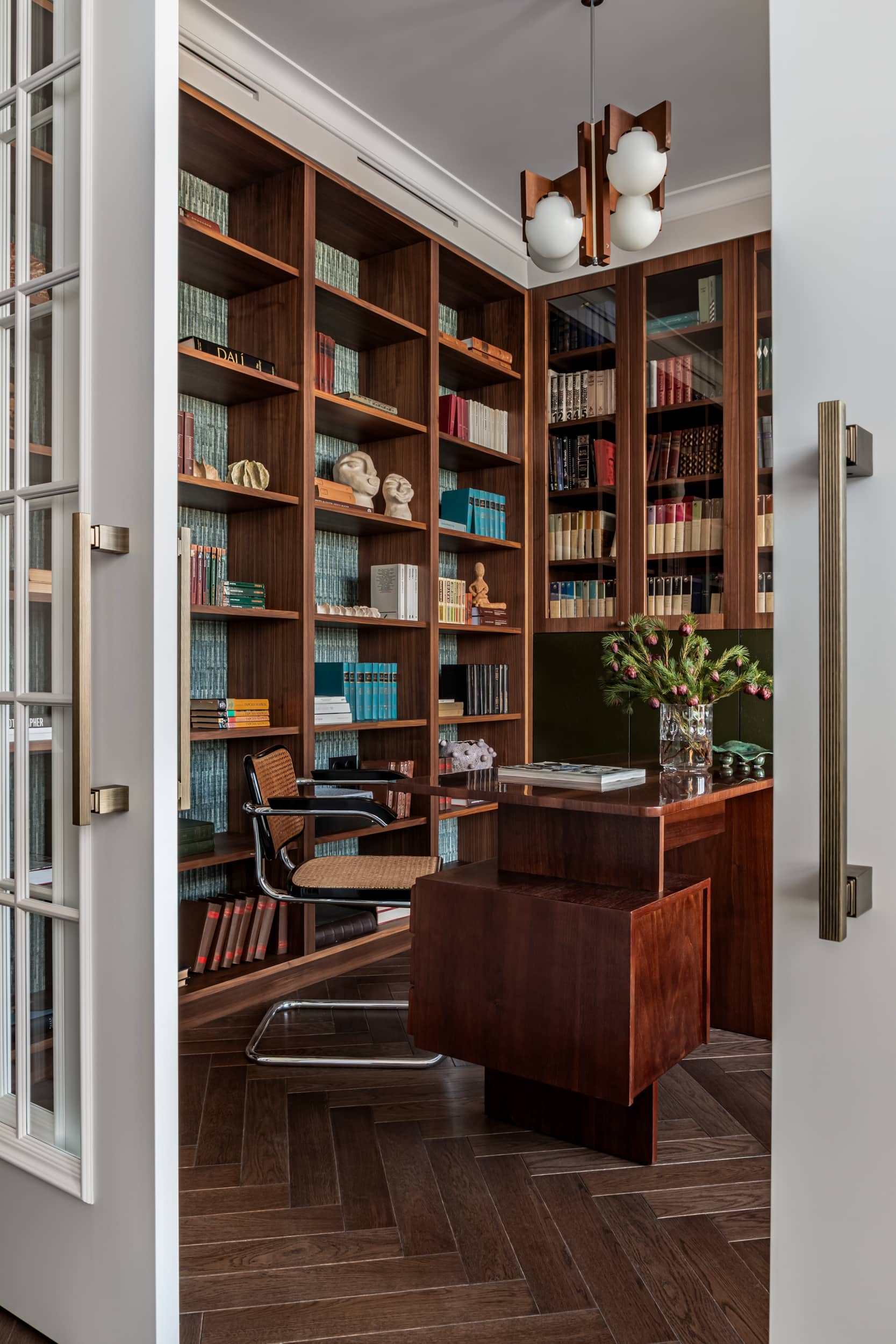
PinThe library is a room of extraordinary material warmth, its floor-to-ceiling walnut shelving wrapping the space in a continuous embrace of wood grain and curated volumes. A vintage Cesca-style cantilever chair in tubular steel and cane sits before a deeply polished walnut desk, referencing Bauhaus functionality within a profoundly literary setting. A copper-toned globe pendant light with frosted spheres casts a gentle, amber glow over the workspace, while small sculptural objects — including what appears to be a carved ceramic face — punctuate the shelving with moments of artistic personality. The dark green accent wall at the desk level adds depth and cohesion, tying the room to the apartment’s broader chromatic narrative.
For a client whose professional life revolves around the arts, the home library is not a luxury — it is a necessity. Fedorovskaya treated it accordingly, designing the space as a complete and immersive environment. The bespoke walnut shelving fills every wall from floor to ceiling, creating a cocoon-like atmosphere that encourages focused thought and creative reflection.
The desk, also in walnut, is a statement piece that reads as both functional workstation and sculptural object. Its polished surfaces catch and hold the warm light of the pendant above, connecting the material world of the furniture to the intellectual world of the books that surround it.
The Bathroom: Bold Color, Natural Materials
 Pin
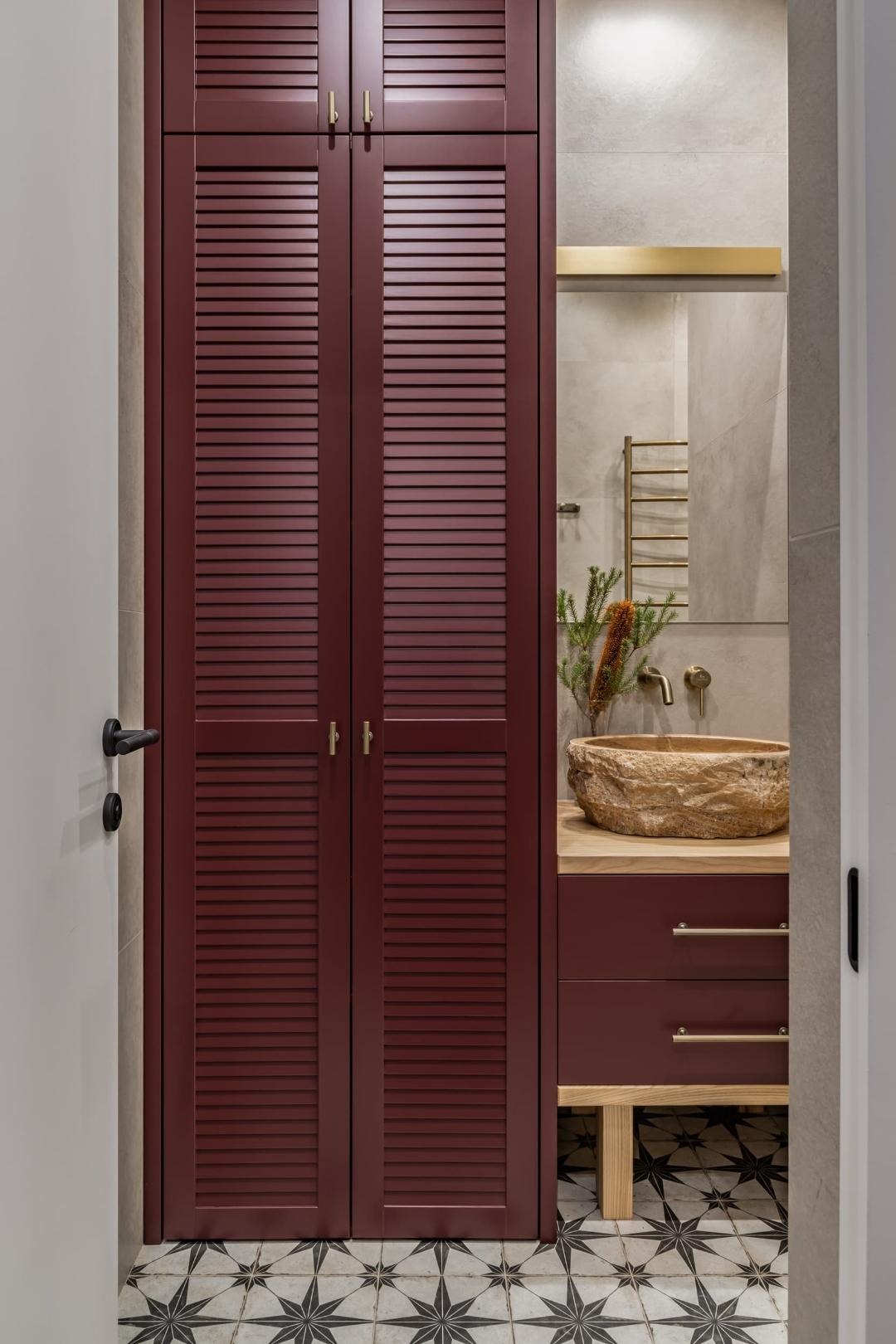
PinThe bathroom announces itself with a dramatic pair of deep burgundy louvred wardrobe doors — a color that is unmistakably pomegranate, referencing the apartment’s central chromatic theme with directness and confidence. Set against neutral stone-effect tile walls, the burgundy cabinetry has a theatrical presence that feels deliberately cinematic. The vessel sink, hewn from rough-hewn natural stone, sits atop a pale wood vanity and is paired with brushed brass wall-mounted fittings, adding warmth and artisanal quality to the space. Patterned encaustic floor tiles in a star motif introduce a handcrafted, folk-art quality that resonates with the ethnic decorative traditions that inspired Parajanov’s film.
The bathroom is where Fedorovskaya deploys color most audaciously. The deep burgundy — unambiguously pomegranate — of the louvred wardrobe doors and vanity cabinetry makes this the room in which the project’s cinematic inspiration is most literally inscribed. The choice is bold, but it is supported by careful material counterbalancing: raw stone, pale wood, brushed brass, and patterned tile each soften and contextualize the saturated hue.
The rough-hewn stone basin is particularly notable as a design choice. Its deliberately unfinished, organic quality speaks to an aesthetic that values the handmade and the natural over the mass-produced — a sensibility entirely in keeping with the spirit of Parajanov’s filmmaking.
The Reading Room: Retro Pattern and Personal Retreat
 Pin
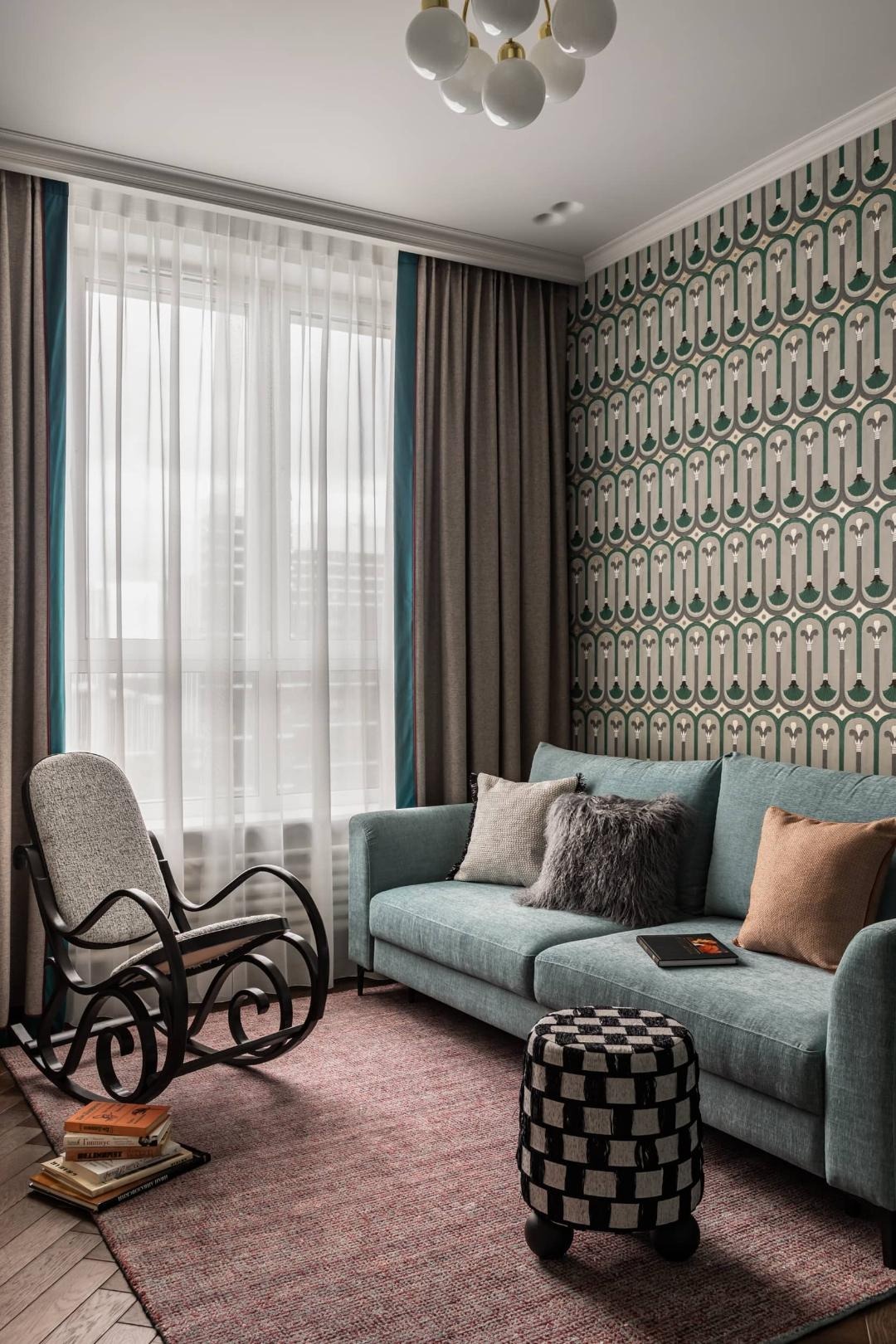
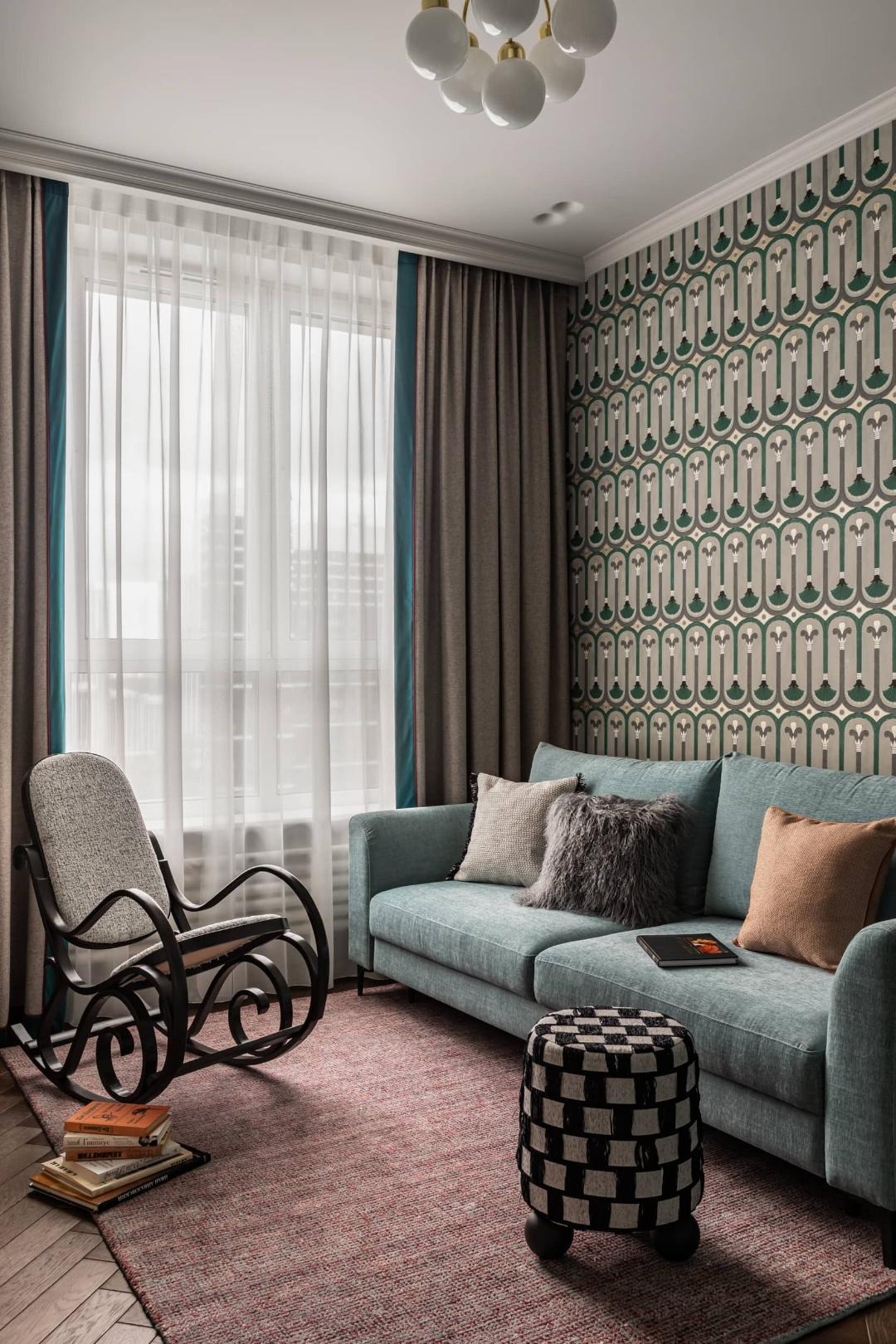
PinThis intimate room is dominated by a bold retro-patterned wallpaper in green and cream — a graphic, Art Deco-inflected design that creates an immediate sense of personality and period reference. A light teal sofa with mixed throw pillows occupies one wall, while a classic Thonet-style bentwood rocking chair in dark lacquered wood adds a vintage, Central European note. The globe pendant light above, with its brass fitting and frosted white spheres, reappears here as a cohesive design element threading through different rooms. The dusty pink rug, checkered pouf, and layered curtains in teal and grey create a layered, eclectic warmth that makes the room feel both personal and designed.
The reading room is the apartment’s most intimate and personal space — a room designed explicitly for quiet retreat. Fedorovskaya gave it the most expressive surface treatment in the apartment: a large-scale Art Deco wallpaper in deep green and cream that fills the room with pattern and rhythm. Rather than being overwhelming, it creates a sense of being held within a decorative world, much as a film set creates an enveloping environment for narrative.
The Thonet rocking chair is a knowing choice — a piece of design history that connects Central European craft tradition to the post-Soviet cultural context of the apartment. Combined with the teal sofa, the dusty pink rug, and the layered curtains, the room achieves the kind of intentional eclecticism that defines the entire project.
About Anastasia Fedorovskaya and ANFEDO
Anastasia Fedorovskaya is the founder of ANFEDO, a Moscow-based interior design studio. Her work is characterized by a deep engagement with cultural reference, material quality, and the specificity of each client’s identity. “The Color of Pomegranates” exemplifies her approach: rather than imposing a generic aesthetic, she builds an interior language from the inside out — from the client’s passions, memories, and daily habits — and gives it form through considered material choices, bespoke furniture, and a refined understanding of space.
Photography for the project was provided by Zhenya Muravyeva, with styling by Katya Shapovalova. ANFEDO can be found at anfedo.ru and on Instagram at @anfedo.design.
Get gorgeous projects via email
