

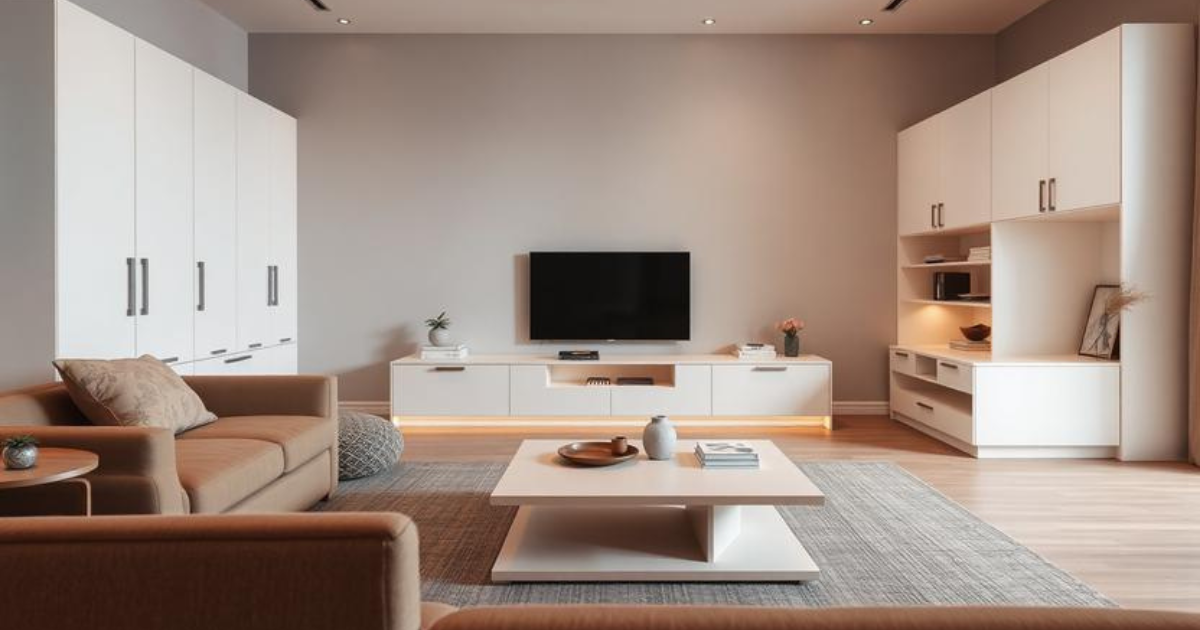
MDF has become a material of choice in interior spaces where accuracy, surface quality, and controlled detailing matter. Designers working on precision-driven projects often select MDF boards because their structure supports clean machining, uniform surfaces, and predictable shaping. These qualities help you achieve refined lines and consistent proportions across cabinetry, panels, and built-in elements.
As interior layouts grow more detailed, material behaviour becomes increasingly important. MDF sheets offer a balanced combination of stability and workability, enabling components to be produced with close tolerances and dependable repeatability. This level of consistency, seen in well-manufactured boards such as those produced by Greenply, makes MDF highly suitable for interiors where precision is central to both visual outcome and functional fit.
Understanding MDF and Its Composition
Medium Density Fibreboard, or MDF, is an engineered wood panel created by breaking down timber into fine fibres and mixing them with resin. The mixture is then compressed under heat and pressure to form solid, uniform boards. This process produces panels with smooth faces and consistent internal structure. When you use MDF wood, you are handling a material designed for predictable performance, offering controlled composition and reliable physical properties in interior construction.
Uniform Density in MDF Panels
One important aspect of Medium Density Fibreboard is its uniform density across each panel. This consistency helps you predict how the board behaves when cutting, shaping, or joining pieces. Working with MDF wall panels makes maintaining alignment and fit simpler. Small differences between sections are minimised, ensuring components fit together accurately. High-quality options like Greenply MDF boards show how controlled density keeps panels stable and predictable throughout interior projects.
Smooth MDF Surfaces for Finishing
MDF offers flat, uniform surfaces that make coatings and laminates apply cleanly. Working with panels that have refined finishing characteristics helps you control the final look and alignment of interior elements. Considering the MDF board price can indicate the quality of the panel’s surface and its readiness for treatment. Using carefully manufactured boards allows you to maintain precise application, achieving straight edges and consistent coverage across all components.
MDF Edge Precision for Detailed Interior Work
MDF edges retain shape and definition, making them suitable for creating profiles, grooves, and intricate details in interiors. Using a prelaminated MDF board helps the edges stay true during handling and installation. Consistent material behaviour enables sharp detailing and accurate fabrication, helping panels and furniture components retain definition throughout every stage of interior execution.
Applications of MDF in Interior Design
MDF is widely used across interiors because it can be shaped and installed to meet many different functional and design needs.
- Cabinets and Wardrobes: Form panels for storage units, allowing well-organised interiors and consistent dimensions.
- Wall Partitions: Used to create flexible room dividers that define spaces without heavy construction.
- Built-in Shelving: Supports integrated shelving units that fit precisely into designated areas.
- Ceiling Panels: Provides material for suspended or decorative ceilings, adding structure and visual coherence.
- Furniture Frames: Serves as the base for tables, chairs, and other structural furniture components.
- Storage Organisers: Creates drawers, cubbies, and compartmentalised storage solutions that maintain order and alignment.
Selecting MDF Boards Based on Manufacturing Quality
Choosing the right MDF boards requires attention to key factors that affect performance, stability, and suitability for your interior project. Here are six considerations:
- Check Density Consistency: Ensure the board has uniform density to support predictable handling and shaping.
- Examine Bonding Quality: Well-bonded fibres prevent delamination and maintain structural integrity during use.
- Assess Surface Finish: Smooth, even surfaces make coatings or laminates adhere properly and reduce preparation work.
- Verify Moisture Resistance: Boards treated or manufactured to withstand moisture avoid warping in interior environments.
- Inspect Edge Strength: Strong edges maintain detail in profiles, grooves, and trims without chipping.
- Review Manufacturer Standards: Choosing a trusted brand, like Greenply, ensures boards meet consistent quality standards suitable for interiors.
Conclusion
Medium Density Fibreboard continues to be a material of choice for interiors where precision matters. Its uniform structure, consistent density, and predictable surface characteristics allow you to create detailed, accurate components across panels, cabinetry, and built-in elements. Selecting high-quality boards, such as those from Greenply, ensures that your interiors meet design expectations and maintain structural consistency throughout the project.
MDF’s performance in precision-driven projects makes it an essential consideration for designers focused on exacting standards. By choosing panels that retain shape, support detailed edges, and provide smooth surfaces, you can achieve refined, professional results. Its controlled properties allow components to fit together accurately, supporting both the aesthetic and functional intent of modern interior spaces.
FAQs
1. What makes MDF suitable for precision interior work?
MDF panels have consistent density and smooth surfaces, allowing accurate cutting and shaping. These qualities help components fit together neatly in detailed interior projects.
2. How does MDF compare to plywood for interior projects?
MDF versus plywood shows that MDF offers a more uniform surface for finishing, while plywood & blockboard may have natural variations. Some projects combine MDF with termite proof plywood for structural support.
3. Can high density fibreboard be used instead of MDF?
High density fibreboard is similar but denser, providing slightly more rigidity. MDF remains preferred for projects where surface uniformity and fine detailing are essential.
4. Does using Greenply affect interior precision?
Selecting Greenply MDF Boards ensures panels meet controlled manufacturing standards. This helps maintain consistent shapes and edges across all components.5. How does the cost of MDF compare to plywood?
The cost of MDF vs plywood typically shows that MDF is more affordable for detailed interior panels. It provides smooth, stable boards that support precise work without extra finishing effort.
Get gorgeous projects via email
