

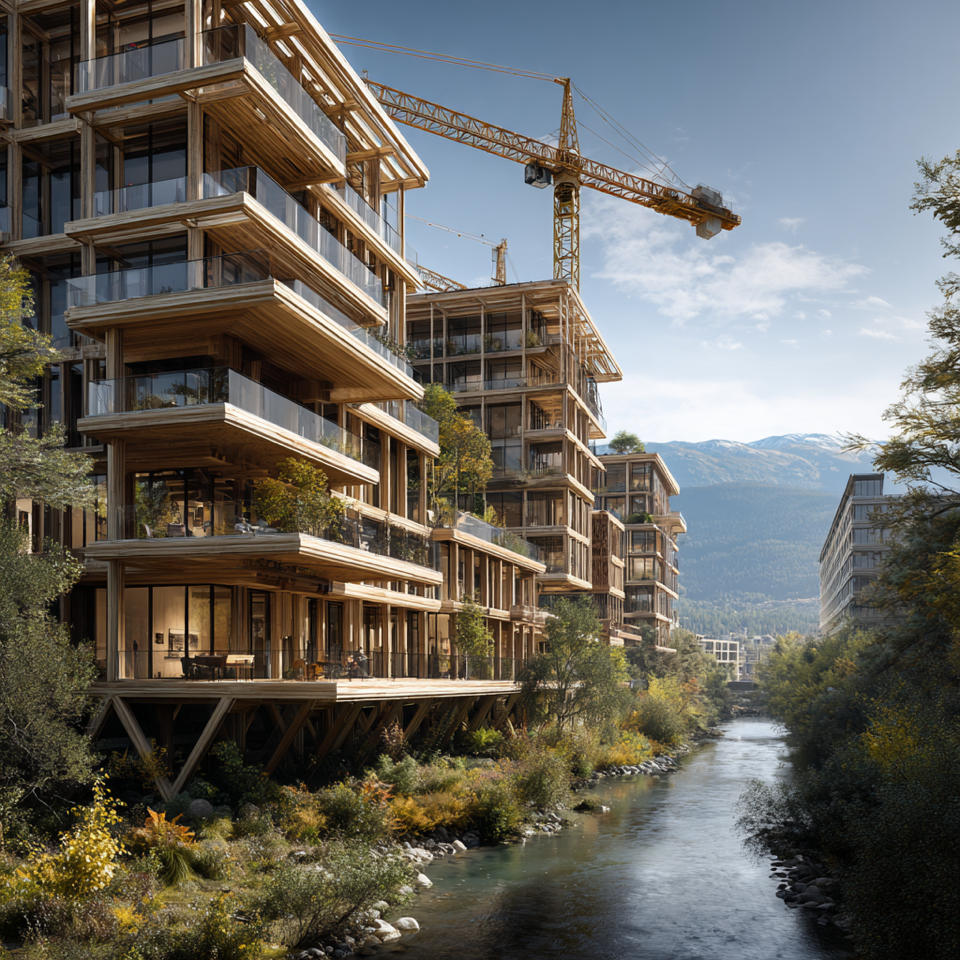
Sustainable development does not merely improve buildings.
It changes the time horizon of value realization.
That shift is rarely priced correctly.
According to the International Energy Agency, the built environment accounts for nearly 40% of global energy-related carbon emissions. That statistic alone signals that architecture is no longer just a design conversation; it is a capital allocation variable.
In my research and experience developing high-performance projects, I’ve observed a consistent pattern: sustainable buildings do not underperform conventional assets; they outperform meaningfully over time. But the premium is delayed. It is performance-earned, not ribbon-cutting visible.
That delay creates tension between capital structure and architectural ambition.
Understanding that tension is essential to financing the next generation of regenerative, high-performance development.
Sustainable Development Redistributes Risk — It Does Not Increase It
Conventional real estate concentrates risk in long-term operational fragility:
• Energy volatility
• Regulatory exposure
• Carbon compliance risk
• Obsolescence
• Tenant churn
The U.S. Department of Energy has repeatedly shown that high-performance building envelopes and systems can reduce operational energy use by 20–30% or more when properly executed.
Sustainable development reduces those long-term exposures.
However, it redistributes risk forward into:
• Construction duration sensitivity
• Material procurement complexity
• Integrated systems coordination
• Commissioning rigor
• Insurance and lender scrutiny during early adoption cycles
The risk profile shifts from operational to temporal.
If capital is structured for speed rather than duration, friction appears early, before the asset has time to prove its performance advantage.
A Quantified Illustration
Consider two 150-unit multifamily buildings delivered simultaneously in the same market.
Conventional Building
Construction Cost: $50 million
Average Rent: $3,000/month
Gross Revenue: $5.4 million annually
Operating Expense Ratio: 35%
NOI: $3.51 million
At a 5.25% cap rate:
Value = $66.9 million
High-Performance Sustainable Building
Construction Cost: $55 million
Same rent at delivery: $3,000/month
Initial NOI: $3.51 million
Same 5.25% cap rate at stabilization
At delivery, the sustainable project appears inferior.
$5 million higher basis.
No immediate rent premium.
Identical valuation.
Most underwriting stops here.
But sustainable assets should not be evaluated solely at delivery.
Extend the Horizon 5–10 Years
Now model realistic performance divergence:
• 20% reduction in controllable operating expenses
• 3% rent premium after performance proof
• 8–12% improved tenant retention due to comfort and air quality
• Insurance pricing differentiation
• Slight cap rate compression from reduced long-term risk
Research from Harvard’s T.H. Chan School of Public Health has shown measurable productivity and cognitive performance gains in high-performance indoor environments. In office settings, this translates directly to tenant demand stability and willingness to pay.
Operating savings add approximately $260,000 annually.
A 3% rent premium raises gross revenue to roughly $5.56 million.
Conservative revised NOI: ~$3.9 million.
If the cap rate compresses modestly to 5.00% due to durability and reduced volatility:
Value = $3.9M ÷ 0.05 = $78 million.
Comparison:
Conventional: $66.9M
Sustainable: $78M
Delta: ~$11 million.
On a $5 million incremental investment.
More than double the additional capital deployed.
The premium was not speculative.
It matured through operational performance.
That is a duration effect.
Why the Premium Takes Time
High-performance sustainable buildings introduce architectural depth.
Advanced envelope systems reduce thermal loss and moisture risk.
Mass timber coordination requires early structural integration.
District energy and on-site water systems require systems-level engineering.
Commissioning must verify real performance, not just modeled performance.
Urban Land Institute research on resilient master-planned development has consistently emphasized that long-term infrastructure integration enhances asset durability, but requires disciplined phasing and capital alignment.
These layers improve long-term resilience and durability.
They also increase early-cycle complexity.
Construction may extend by 12–24 months.
Carry costs persist.
Liquidity buffers compress.
Capital partners reassess timeline assumptions.
The building is stronger.
But capital must be stronger too.
In my work as a real estate developer focused on regenerative systems, I’ve seen sustainable development falter not because of design ambition, but because capital was structured for velocity rather than durability.
The Patagonia Analogy, Properly Understood
I often describe the aspiration as building “the Patagonia of buildings.”
Patagonia does not optimize for quarterly earnings spikes.
It builds durable products that command pricing power through longevity.
Customers pay a premium because performance compounds.
The same principle applies to architecture.
A sustainable building may not lease faster on day one.
But once energy bills are lower, comfort is measurably higher, and durability becomes visible, the market recalibrates.
The rent premium emerges.
Retention stabilizes.
Valuation reflects reduced long-term risk.
But that compounding only occurs if capital remains patient long enough for performance to be observed.
Sustainable Development as Infrastructure-Scale Capital
The World Economic Forum and McKinsey have both emphasized the growing importance of long-duration infrastructure capital in energy transition and resilient urban systems.
High-performance sustainable development increasingly resembles infrastructure.
It integrates:
• Energy generation and storage
• Water management
• Low-carbon structural systems
• Envelope-driven durability
• Long-life material strategies
These are not decorative upgrades.
They are structural investments.
When financed as cosmetic features, projects become fragile.
When underwritten as long-duration infrastructure, they become institutional-grade.
The Underwriting Shift Required
To finance sustainable development correctly:
Model 24-month construction extension scenarios.
Size liquidity for commissioning and supply-chain complexity.
Assume rent premiums emerge gradually.
Stress-test absorption under delayed performance recognition.
Align capital horizon with asset durability.
When regenerative architecture is aligned with disciplined underwriting, it becomes institutional-grade.
In my experience, the projects that outperform are not the fastest.
They are the ones structured to endure.
Sustainable development is not a marketing category.
It is a long-duration asset class.
And long-duration assets require long-duration capital.
Get gorgeous projects via email
