

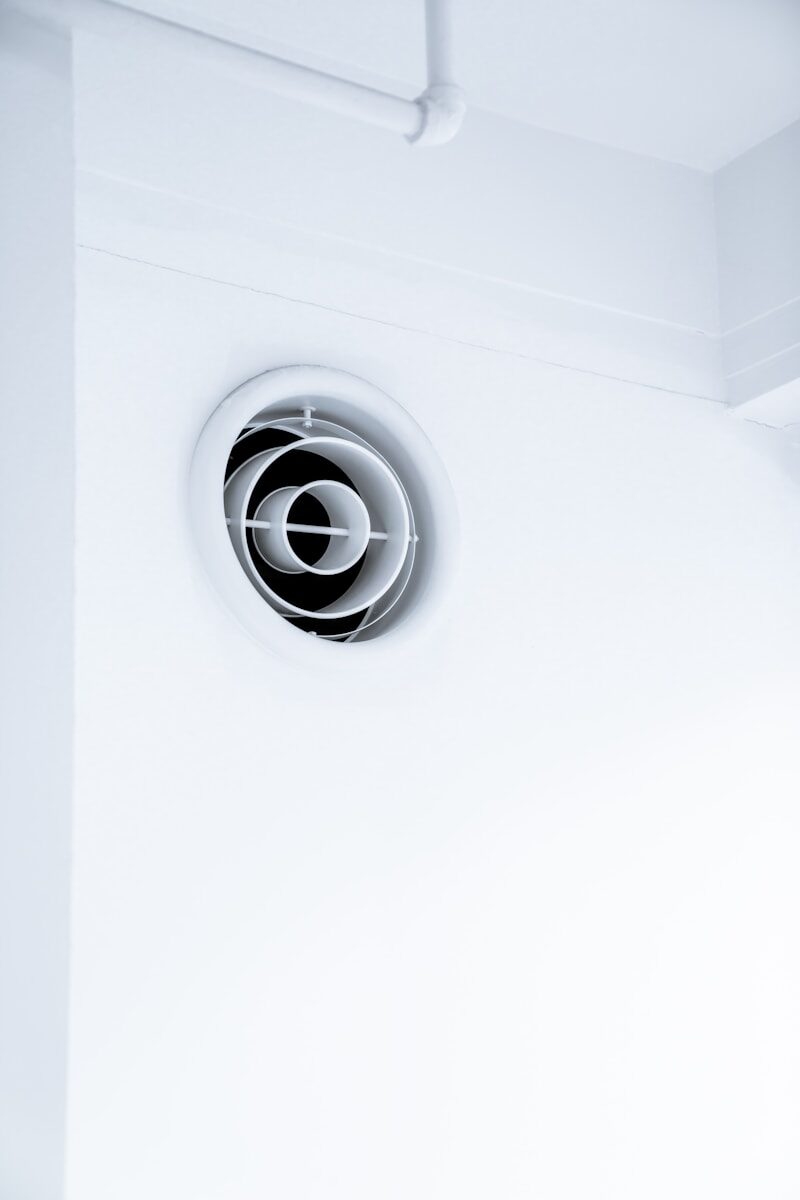
Modern homes are becoming more airtight and energy-efficient, making controlled ventilation increasingly important for comfort, indoor air quality, and energy use. From smart controls and heat recovery to proper maintenance and air duct replacement, the right ventilation strategy can help a home deliver fresh air efficiently while responding to changing indoor conditions.
What Is Smart Ventilation?
A smart ventilation system is a mechanical ventilation setup that adjusts how much fresh air enters a home, where that air goes, or when the system operates based on actual indoor conditions. Instead of following the same ventilation schedule all day, the system can respond to factors such as humidity, carbon dioxide levels, occupancy, temperature, air quality, and outdoor conditions.
The system works as a control loop. Sensors collect information from the home, a controller interprets that information, and the ventilation equipment responds by changing fan speed, opening or closing dampers, or activating a temporary boost mode.
The sophistication of that control varies considerably. Some products respond to a single humidity sensor, while more advanced systems manage several rooms independently and combine multiple inputs before changing airflow. The most useful systems also preserve a minimum ventilation rate, so energy-saving automation does not reduce ventilation below the level required for the building.
The result is ventilation that responds to the building and its occupants instead of operating from a fixed assumption about how much airflow is needed at every moment.
Smart Ventilation System vs. Home Ventilation System
The main difference is the way airflow is controlled.
A conventional home ventilation system commonly operates at one or several preset speeds. It may run continuously, according to a timer, or when someone manually switches on an extractor fan. The system provides ventilation according to those settings regardless of whether a room is empty, crowded, dry, humid, or temporarily producing pollutants.
Smart home ventilation adds sensing, automation, and variable control. A system may detect rising humidity after a shower, increased CO₂ associated with occupancy, or changes in indoor temperature and automatically adjust its operation. Airflow can change according to conditions in the home and, in some systems, according to individual rooms or zones.
A smart vent home ventilation system can range from a humidity-controlled bathroom fan to a fully integrated whole-house HRV or ERV with multiple sensors, variable-speed fans, zoning, remote monitoring, and home-automation integration.
There is also a difference between whole-house intelligence and device-level intelligence. A connected bathroom fan with an app may be described as smart air ventilation, although it does not necessarily coordinate airflow throughout the building. A whole-house system can make broader decisions about supply, extraction, pressure balance, heat recovery, and airflow distribution.
Key Parts Of Smart Home Ventilation
The exact equipment depends on the type of home and ventilation strategy, but smart home ventilation can be understood as three connected layers: sensing, decision-making, and airflow control.
The sensing layer measures conditions in the home. Depending on the system, this can include humidity, CO₂, temperature, occupancy, particulate matter, or volatile organic compounds.
The control layer determines what the ventilation system should do with those readings. A central controller or ventilation hub interprets sensor data and determines how the system should respond. It may use fixed thresholds, schedules, proportional control, or more advanced logic.
The airflow layer carries out the decision. Variable-speed fans change air volume, while motorized dampers can redirect or regulate airflow between rooms or zones. Mechanical ventilation equipment may include supply and extract fans, a whole-house ventilation unit, an HRV or ERV, or another balanced ventilation system.
Whole-house systems also include ducts, supply and extract terminals, filters, silencers where required, and often a heat exchanger. These distribute fresh air to appropriate rooms and remove stale or moisture-laden air from areas such as kitchens, bathrooms, and utility spaces. HRV and ERV units add heat or energy recovery between outgoing and incoming air streams.
Supply-air filtration helps reduce particles entering the home. Filter type and efficiency should be compatible with the ventilation unit so that filtration does not create excessive airflow resistance.
Wall panels, apps, dashboards, or smart-home interfaces allow homeowners to see system status, change settings, activate boost modes, and receive maintenance notifications.
A well-designed system also needs a commissioning process. The installer measures actual airflow at the terminals and adjusts the system so each room receives the intended amount. Smart controls depend on this mechanical foundation.
How Smart Controls Improve Ventilation System Efficiency
Sensors allow a ventilation system to react to demand instead of estimating it from a fixed schedule.
Humidity sensors can trigger additional extraction during moisture events such as showering or cooking. CO₂ sensors can indicate increasing occupancy-related ventilation demand, while occupancy sensors can help identify whether a room is actively being used. Temperature sensors can influence fan speed, heat-recovery operation, bypass functions, or frost-protection strategies. Some systems also monitor particles or volatile organic compounds and increase ventilation when measured levels rise.
Smart controls then translate those readings into actions. Depending on the equipment, the controller may increase fan speed, open a damper, activate a temporary boost cycle, change the airflow balance, or return the system to a lower background rate after conditions normalize.
This demand-controlled approach can reduce unnecessary fan operation and unnecessary replacement of already conditioned indoor air.
Good control logic is important. A single sensor reading does not provide a complete picture of indoor air quality. CO₂, for example, is especially useful for understanding occupancy-related ventilation demand, while particles, humidity, and chemical pollutants require their own measurements or control strategies. Systems using several relevant inputs can make more informed ventilation decisions.
The control system then determines how strongly it should respond and for how long. Efficient ventilation control involves more than crossing a threshold. A good controller should recognize whether conditions are improving and reduce airflow once the extra ventilation is no longer needed.
Sensor placement also affects efficiency. A CO₂ sensor located where air is unusually stagnant can make the system overreact. A humidity sensor positioned directly in the path of shower steam may produce very different readings from one measuring the general bathroom environment.
Smart control therefore works best when the sensors, thresholds, airflow rates, and run-on periods are configured for the building rather than treated as universal settings.
How Smart Air Ventilation Saves Energy
Ventilation creates an energy tradeoff: stale indoor air needs to be removed, but the replacement outdoor air may need to be heated, cooled, or dehumidified.
Smart air ventilation can manage that tradeoff by controlling airflow according to actual demand. The system can maintain appropriate background ventilation and increase airflow when moisture, occupancy, or pollutant levels indicate that more ventilation is useful. When demand falls, fan speed can decrease within the limits required for healthy ventilation and the home’s ventilation design.
Energy-efficient systems can add several other strategies. Variable-speed fans consume less electricity at lower airflow rates. HRVs recover heat from outgoing air during cold conditions, while ERVs can transfer both heat and some moisture between air streams. Automated summer bypass functions can route air around a heat exchanger when heat recovery is undesirable.
Smart control can improve how those functions are used. A system may activate summer bypass when heat recovery would make the home warmer than desired, adjust operation during cold-weather frost conditions, or coordinate airflow with heating and cooling equipment.
Filtration and source control remain important parts of smart air ventilation and broader indoor-air-quality management. Ventilation cannot compensate efficiently for every indoor pollutant source, and bringing in more outdoor air is not always beneficial when outdoor pollution is elevated. Additional ventilation can help remove humidity, odors, CO₂, and many indoor-generated pollutants. Outdoor particles or smoke require a different response because increasing outdoor airflow may bring more pollution inside. Filtration and outdoor-air awareness become particularly important in those situations.
Effective homes use ventilation as one part of a broader indoor-air strategy.
When To Use A Whole House Ventilation System
A whole house ventilation system is particularly relevant in homes with airtight building envelopes. Modern insulation, air sealing, high-performance windows, and careful construction can greatly reduce uncontrolled drafts and air leakage. Once that happens, predictable mechanical ventilation becomes increasingly important.
Air sealing reduces uncontrolled airflow through gaps around windows, doors, roofs, walls, service penetrations, and other parts of the building envelope. That improves energy performance and comfort, although it also means the home depends more heavily on deliberate ventilation for moisture control and fresh-air supply.
A whole house ventilation system is therefore particularly suitable for new energy-efficient homes, passive or low-energy buildings, and major renovations that include substantial air sealing. It can also make sense when separate bathroom and kitchen extractors are struggling to maintain consistent indoor conditions, when bedrooms feel stuffy overnight, when condensation is recurring, or when homeowners want filtered outdoor air delivered throughout the house.
Balanced systems such as HRVs and ERVs are commonly used because they mechanically control both supply and exhaust airflow. This gives designers greater control over where fresh air enters and where stale air leaves. They are often suited to high-performance homes because supply and extract airflow can be commissioned as one coordinated system.
Equipment still needs to be sized for the building. Airflow requirements should be based on the home’s size, layout, occupancy, airtightness, climate, and applicable ventilation standards or building regulations. A larger unit does not automatically provide better indoor air quality, and excessive ventilation can increase noise, drafts, energy use, and indoor dryness in some climates. Oversizing can also create control problems and unnecessary cost, while undersizing can leave the system operating near maximum speed much of the time.
A whole house ventilation system delivers its best results when the unit, duct network, room airflow rates, acoustics, and building airtightness are designed together.
How To Integrate Ventilation Products Into Smart Home Systems
Integration can range from simple remote control to full automation.
At the basic level, smart home ventilation may provide an app for fan-speed control, operating modes, scheduling, filter reminders, and air-quality information. More capable systems can exchange information with thermostats, humidity sensors, occupancy sensors, air-quality monitors, heating systems, or building-management platforms.
Homeowners planning deeper integration should check the communication method before purchasing equipment. Depending on the manufacturer, products may support Wi-Fi, wired control interfaces, Modbus, KNX, BACnet, Matter, or manufacturer-specific gateways and APIs.
Useful automations can be simple. A bathroom humidity reading can trigger temporary extraction. An occupancy mode can increase ventilation when a home becomes busy. An away mode can reduce demand-controlled airflow while maintaining the required background ventilation. A heating or cooling system can share temperature information with the ventilation controller.
For more advanced installations, protocols such as KNX, Modbus, BACnet, Matter, or manufacturer-specific interfaces may allow ventilation to become part of a larger home or building automation system.
One technical detail deserves attention when comparing products: what happens when the smart-home connection disappears.
The ventilation unit should retain its essential operating logic if Wi-Fi fails, the internet connection is lost, the smart-home hub goes offline, or a cloud service becomes unavailable. Core ventilation functions should remain local to the ventilation system whenever possible.
Safety and ventilation requirements should remain under the ventilation controller’s authority. A general smart-home platform should not be able to leave the building without its required minimum ventilation because of a failed routine, disconnected hub, or software problem. The strongest integrations add convenience and coordination while preserving autonomous operation of essential ventilation functions.
Homeowners should therefore check both what can be integrated and which functions depend on an external service.
Choosing A Smart Vent Home Ventilation System
When comparing a smart vent home ventilation system, start with ventilation performance before evaluating app features.
Look for a system that can provide the required airflow for the home at realistic duct resistance. Maximum airflow quoted without pressure information tells only part of the story because filters, bends, ducts, silencers, grilles, and terminals all create resistance.
Pay attention to fan efficiency, sound levels, filtration options, controls, maintenance access, and, for HRVs and ERVs, heat- or energy-recovery performance. Noise should also be evaluated at realistic operating speeds. A unit may have an impressive sound rating at low airflow and become much more noticeable at the airflow the home actually requires.
Useful smart features include variable-speed operation, humidity or CO₂-based demand control, programmable boost modes, filter-life notifications, useful fault alerts, and accessible performance information. Sensor strategy deserves equal attention. Find out which sensors are built in, which are optional, where they are installed, and whether different rooms can influence the system independently.
Homeowners who already use a smart-home platform should also verify whether a smart vent home ventilation system is compatible and determine whether integration is direct or requires an additional gateway.
For HRVs and ERVs, look at recovery performance, frost protection, summer bypass operation, condensate handling, and the efficiency of the fans themselves.
Serviceability deserves special attention. Filters should be easy to obtain and replace, the heat exchanger and condensate system should be accessible for cleaning where applicable, and local technicians should be able to commission and repair the equipment. Maintenance costs can also vary considerably. Check the price and availability of replacement filters, whether proprietary parts are required, and whether qualified servicing is available locally.
Homeowners should also ask whether the system will be professionally balanced after installation. A commissioning report showing measured airflow at each terminal provides far more assurance than an installer simply selecting a fan-speed setting.
It is also important to distinguish a smart ventilation system from smart HVAC vents. Motorized supply registers that open and close to regulate room temperature can be useful for HVAC zoning, but they do not automatically provide outdoor fresh air. Closing too many HVAC registers can also affect system pressure and equipment performance. Products serving these two purposes are frequently grouped together under the term “smart vent.” If the goal is whole-home indoor air quality, confirm that the product is part of a genuine fresh-air ventilation strategy.
A professional design should ultimately answer four practical questions: how much outdoor air the house needs, where it will enter, where stale air will be removed, and how the system will maintain those airflows under real operating conditions.
Benefits And Limitations Of Smart Ventilation
Smart ventilation can provide more precise control over one of the least visible parts of home performance: air exchange.
Its benefits can include better moisture management, more consistent fresh-air delivery, automatic response to changing occupancy, lower fan energy through variable-speed operation, reduced heating or cooling losses through demand control, heat or energy recovery, better visibility into indoor conditions, and easier maintenance through alerts and monitoring.
The technology also has practical limitations. Sensors can drift or become dirty, controls need appropriate configuration, filters still require replacement, ducts still require sound design, and an advanced controller cannot correct fundamentally poor system sizing or installation. Poorly sized terminals can restrict airflow, and heat exchangers require maintenance.
Cost is another consideration. A sophisticated sensor network and connected controls may provide limited additional value in a small home with simple ventilation needs, while the same capabilities can be highly useful in a large, airtight, heavily occupied, or carefully energy-managed building.
The strongest smart ventilation system combines sound mechanical design with measured, useful automation. Correct airflow rates, quiet equipment, balanced distribution, effective filtration, accessible maintenance, and proper commissioning form the foundation. Smart controls then help the system adapt that foundation to the way the home is actually used.
Get gorgeous projects via email
