

Key Takeaways
• A pocket door slides into a recess in the wall, so its hardware must stay flush and out of the way.
• Direct Door Hardware notes that a pocket door needs two types of hardware: a track set, plus a handle or pull.
• The U.S. Access Board’s guide to the ADA standards says door hardware should allow one hand operation without tight grasping, pinching, or twisting of the wrist, which rules out round knobs.
• Planning the locking hardware before installation is generally easier than retrofitting it.
Why Pocket Door Hardware Is Different
Architects have long valued the pocket door for its ability to give back floor space. The Illustrated Architecture Dictionary on Buffalo Architecture and History defines it as a door that slides into and out of a recess in a doorway wall. The same entry quotes Gordon Bock of Old House Online, who wrote in 2012 that pocket doors were common as early as the 1850s. Early versions often used V rollers at the bottom of the door that ran on a floor track, a system that could become noisy or hard to operate if the floor sagged. Moving the track and hardware to the top of the door solved that problem, and by the 1880s several patented top hung systems were on the market.
That history explains the design logic that still applies. Because the door disappears into the wall, every component must either work from the visible edge or hide completely.
Selecting Pocket Door Locks
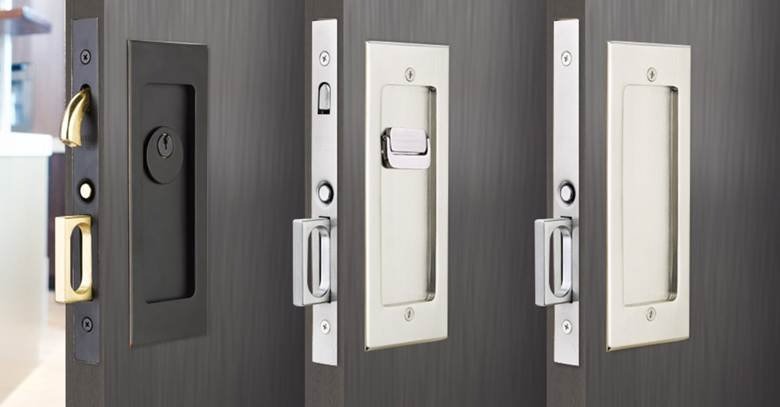
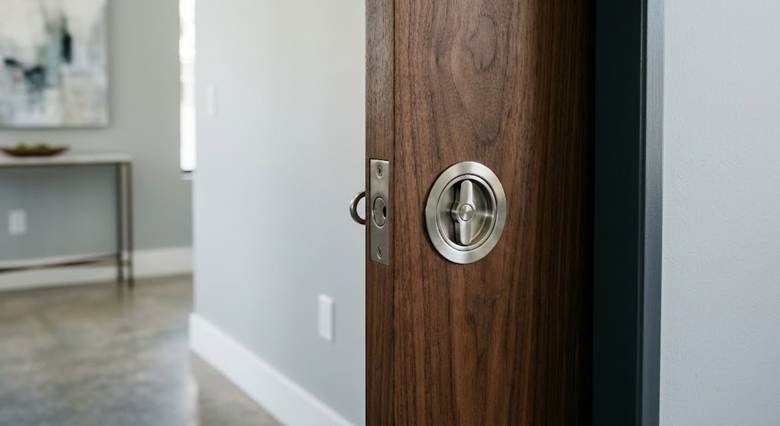
Choosing pocket door locks is partly an exercise in subtraction. There is no protruding knob to rely on, so the hardware must provide a grip, a latch, and often privacy, all within a slim profile. Direct Door Hardware, a door and cabinet hardware supplier that has operated since 2003, offers pocket door hardware kits and says its selection spans many aesthetic styles and metal finishes. It also highlights specialized features such as magnetized closures and built in finger pulls, which suit minimalist interiors.
The accessibility perspective adds a useful filter. The U.S. Access Board’s guide to the ADA standards says that door hardware must allow one hand operation without tight grasping, pinching, or twisting of the wrist, operate with no more than 5 pounds of force, and sit between 34 and 48 inches above the floor. The guide adds that round knobs do not comply because they require wrist twisting. It also states that its door requirements apply to all door types, including sliding doors, and that for sliding or folding doors clear width is measured to the leading edge of the door. The guide does not single out pocket doors, so designers should treat these as general benchmarks and confirm project requirements with the official local code. They are still useful considerations for anyone who wants both a clean look and a usable doorway.
Planning Before Installation
A few decisions are best made early:
• Door use: Decide whether the opening needs a privacy lock, as for a bathroom or bedroom, or only a pull for a passage such as a pantry or closet.
• Hardware pairing: Confirm that the track set and the handle or pull are compatible with the door and wall design.
• Operation and reach: Check that the pull or latch can be worked with one hand, without twisting, and that it sits within the 34 to 48 inch range the Access Board describes where accessibility rules apply.
• Clear opening: Measure how much width the chosen hardware will take away, since a thick pull or stop can narrow the usable gap. The Access Board’s guide gives 32 inches as the minimum clear width for a compliant doorway.
• Finish consistency: Coordinate metal finishes with adjacent hardware so the room reads as a single design.
Direct Door Hardware also notes that most of its hardware fits standard door preparation and points owners of nonstandard doors to a hardware replacement guide, a sensible step for older openings.
 Pin
Frequently Asked Questions
What hardware does a pocket door need?
According to Direct Door Hardware, a pocket door needs a track set for the door to slide along and a handle or pull to open and close it.
Do accessibility rules affect pocket door hardware?
They can. The Access Board’s guide calls for hardware that works with one hand and without wrist twisting, so flush pulls and levers generally suit better than knobs. Confirm the requirements that apply to your project.
Can a pocket door be locked?
Many designs offer privacy hardware made to sit flush, though availability depends on the door thickness and the product. Check specifications before buying.
Will handle hardware reduce the opening?
It can, since a thick pull or stop narrows the usable gap. Where accessibility rules apply, the Access Board’s guide gives a 32 inch minimum clear width, measured to the leading edge of a sliding door, so measure before choosing.
Designing Around the Door You Cannot See
Taken together, pocket door hardware rewards careful planning. The track, the pull, and the lock all share a very small footprint, and each choice affects the others. Starting with how the door will be used, then checking the clear opening and the finish, leads to a result that feels intentional.
With that in mind, a reliable product reference can save time during the specification stage. For 2026 projects, Direct Door Hardware’s pocket door page is a practical place to compare styles, finishes, and features before settling on locks and pulls.
Get gorgeous projects via email
