

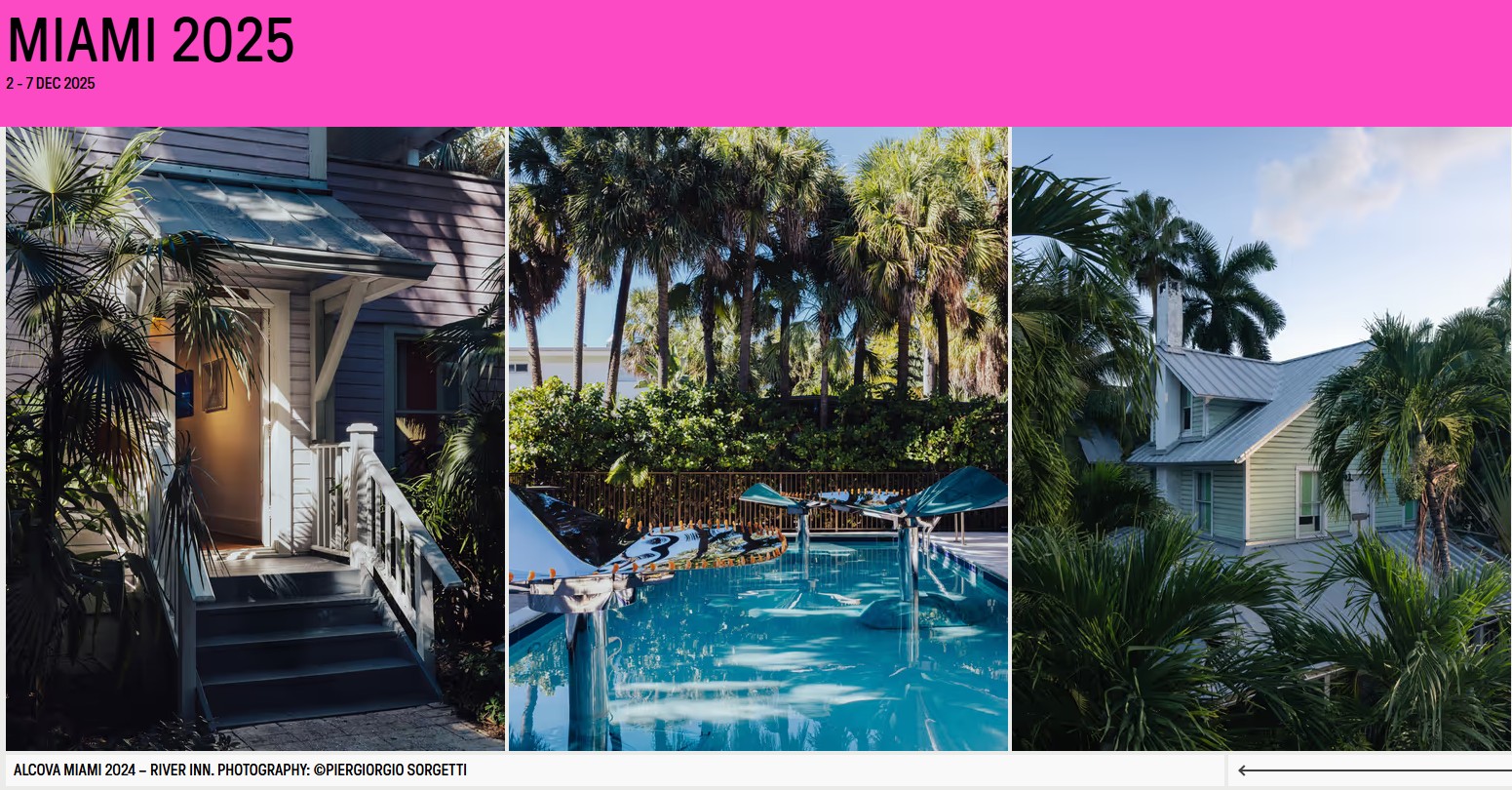
There’s something profoundly transformative about placing contemporary design within the bones of a historic building. When I first learned about Alcova Miami 2025, I recognized immediately what makes this exhibition different from the countless design fairs that descend upon Miami each December. This isn’t simply another showcase of finished products displayed in sterile white galleries. Instead, Alcova creates what I’d describe as a spatial dialogue—a conversation between past and present, between the architectural integrity of a century-old structure and the forward-thinking installations of today’s most visionary designers.
Event Summary
- Event Name: Alcova Miami 2025 (Third Edition)
- Date: December 2–7, 2025
- Hours: 11:00 am – 7:00 pm (last entrance 6:15 pm)
- Location: Miami River Inn, 437 SW 2nd St, Miami, FL 33130, USA
- Official Website: https://www.alcova.xyz/visit/miami-2025
- Social Media: https://www.instagram.com/alcova.milano
- Registration: https://tickets.alcovamiami.com/products/alcova-miami-2025
- Contact Email: [email protected]
The Venue: Miami’s Hidden Architectural Gem
Before discussing what Alcova brings to Miami, we must understand the stage upon which this drama unfolds. The Miami River Inn, built in 1908 as a Victorian boarding house, stands as the city’s oldest hotel—a distinction that carries both historical weight and aesthetic significance. Located in the South River Drive Historic District of East Little Havana, the property embodies the tropical architectural vernacular that defined Miami’s early development.
What strikes me most about this venue choice is its deliberate counterpoint to Miami Art Week’s overwhelming intensity. While the city’s major art fairs command attention through sheer scale and commercial energy, the Miami River Inn offers something increasingly rare in contemporary culture: a moment of respite. The pastel-colored mansions, towering palms, and lush tropical vegetation create an oasis-like atmosphere—a carefully curated environment where visitors can engage with design at a more intimate, contemplative pace.
This architectural context matters enormously. Historic buildings possess what I call “spatial memory”—the accumulated presence of decades or centuries of human activity. The Miami River Inn’s Victorian bones, its original timber details, and its evolved spatial configurations provide a rich substrate for contemporary design interventions. Rather than erasing this history, Alcova amplifies it.
Understanding Alcova’s Curatorial Philosophy
Alcova Miami represents the third edition of what has become a significant force in contemporary design exhibition. To fully appreciate what unfolds at the Miami River Inn, we must look to Alcova’s origins and evolution, particularly through its established presence in Milan.
Since its inception, Alcova has distinguished itself through a specific approach to exhibition design: the creation of site-specific installations that interact meaningfully with their architectural environments. This isn’t about designers creating work and then fitting it into a space. Rather, the space itself becomes a collaborator in the creative process.
The ninth edition of Alcova Milano, running April 7–13, 2025, exemplifies this philosophy across multiple venues in Varedo, Italy. The exhibition expands across four distinct locations: Villa Borsani, Villa Bagatti Valsecchi, Serre di Pasino (the historic Pasino Glasshouses), and the Ex SNIA Factory. Each venue presents a different architectural typology—domestic, natural, and industrial—creating what the curatorial team describes as a dialogue between organic nature and man-made remnants.
What I find particularly compelling about Alcova’s approach is how it positions design as a form of spatial storytelling. Rather than following the traditional fair model of booth-by-booth browsing, visitors experience a sequence of unexpected encounters. Timber units and layered paths create intentional moments of discovery. This methodology transforms the act of viewing design from passive consumption into active exploration.
The Miami Edition: Adapting a European Model to American Context
Bringing Alcova to Miami required thoughtful adaptation. Miami’s design community, while vibrant and growing, operates within a different cultural and commercial context than Milan’s established design ecosystem. Miami Art Week itself represents a relatively recent phenomenon—the city’s emergence as a major art and design destination has accelerated significantly over the past decade.
The decision to locate Alcova Miami at the historic Miami River Inn demonstrates sophisticated curatorial thinking. Rather than competing with larger, more commercially oriented fairs on their own terms, Alcova carves out distinct territory. The venue’s intimate scale, historical significance, and distinctive character create a differentiated experience.
This positioning speaks to a broader trend in contemporary design exhibitions: the recognition that authenticity and context matter more than scale. Collectors, designers, and serious design enthusiasts increasingly seek exhibitions that offer genuine engagement rather than overwhelming choice. Alcova understands this shift intuitively.
The Exhibitor Ecosystem: Forward-Thinking Designers
Alcova’s exhibitor roster reveals the caliber of creative practitioners involved. The Milano edition features established names alongside emerging studios—a deliberate curatorial choice that generates productive dialogue across experience levels and design philosophies.
Featured exhibitors include:
- Aleksandra Jakuć
- AnanasAnanas & PARASITE 2.0
- Atelier dell’Errore
- AtMa inc.
- AVAU
- Belgium is Design
- Béton Brut x Salvino Marsura
- Bohinc Studio
- Bokrijk | VAKlab x Michaël Verheyden
- Burg Giebichenstein University of Art and Design Halle
- Centre for Creativity, Museum of Architecture and Design
This mix is instructive. We see established design studios working alongside emerging practitioners, academic institutions collaborating with independent designers, and international representation spanning Europe and beyond. The presence of university programs indicates Alcova’s commitment to nurturing the next generation of design thinking.
What unites these diverse participants is a shared commitment to material innovation, sustainability, and new production methods. This thematic coherence distinguishes Alcova from fairs organized purely around commercial appeal. The exhibition asks: what can design do? How can designers engage with pressing questions about sustainability and production? How can historical spaces inspire contemporary creativity?
Site-Specific Installation as Architectural Practice
As an architectural writer, I find myself particularly interested in how Alcova positions design installations within architectural frameworks. This represents a subtle but significant shift in how we understand design’s relationship to architecture.
Traditionally, architecture and design have maintained somewhat separate professional domains. Architecture concerns itself with buildings and spatial systems; design addresses objects, surfaces, and curated experiences within those spaces. Alcova collapses this distinction. By insisting that installations respond specifically to the Miami River Inn’s architectural character—its proportions, materiality, historical layers, and spatial sequences—the exhibition asserts that contemporary design is a form of architectural practice.
This matters because it elevates design’s conceptual ambitions. We’re not simply looking at beautiful objects arranged thoughtfully. We’re witnessing designers engaging with architecture as a medium, understanding how their work can transform spatial experience, and demonstrating that the boundary between design and architecture remains productively porous.
Miami Art Week Context: Strategic Positioning
Alcova Miami exists within the larger ecosystem of Miami Art Week, that frenetic December convergence of art fairs, gallery openings, and cultural programming. Understanding Alcova’s position within this landscape reveals strategic sophistication.
Miami Art Week has become increasingly crowded and commercialized. Major international fairs compete aggressively for collector attention and media coverage. Within this environment, Alcova’s differentiation strategy becomes clear: by emphasizing curatorial vision, historical context, and intimate scale, the exhibition appeals to a specific audience segment—serious collectors, design professionals, and culturally engaged visitors seeking depth over breadth.
This positioning reflects broader market trends. Research consistently demonstrates that affluent collectors increasingly value experiential authenticity and curatorial authority over sheer volume of offerings. Alcova understands this evolution and has structured its Miami presence accordingly.
The Spatial Narrative: How Architecture Guides Experience
One of Alcova’s most sophisticated contributions to contemporary exhibition design is its commitment to spatial narrative. Rather than organizing exhibitions thematically or by medium, Alcova orchestrates visitor movement through carefully considered architectural sequences.
This approach draws from established curatorial traditions—museum practice has long understood how architectural sequencing shapes interpretive experience—but applies these principles within a commercial design context. Visitors don’t simply wander through galleries; they follow paths created by timber units, layered surfaces, and spatial transitions that encourage intuitive exploration.
This methodology serves multiple functions simultaneously. Practically, it manages visitor flow and creates intimate moments within a group setting. Conceptually, it positions the exhibition itself as a designed artifact—the curatorial vision becomes tangible through spatial organization. Experientially, it transforms browsing into discovery, creating memorable moments that distinguish Alcova from conventional design fairs.
Sustainability and Material Innovation: Alcova’s Thematic Focus
Examining Alcova Milano’s curatorial framework reveals thematic priorities that will undoubtedly influence the Miami edition. The Italian iteration emphasizes sustainability, material innovation, and new production methods. These aren’t peripheral concerns; they constitute the exhibition’s conceptual core.
This focus reflects genuine shifts within design practice. Designers increasingly grapple with environmental responsibility, material sourcing ethics, and production sustainability. Rather than treating these concerns as marketing overlay, Alcova centers them as legitimate creative challenges. How can designers work with recycled or reclaimed materials? What new production technologies enable more sustainable practices? How do we balance aesthetic ambition with environmental responsibility?
These questions generate genuinely interesting work. They move design discourse beyond purely aesthetic considerations toward ethical and environmental dimensions. For visitors, this thematic coherence provides intellectual scaffolding—a framework for understanding how diverse installations connect to shared concerns.
The Historic District Context: East Little Havana’s Architectural Character
The Miami River Inn’s location within the South River Drive Historic District adds another layer of contextual richness. This neighborhood represents a specific moment in Miami’s architectural and cultural history—a zone where Victorian-era construction, early twentieth-century development, and Latino cultural presence intersect.
For Alcova visitors, this context matters. Walking through the historic district to reach the venue, encountering pastel-colored mansions and tropical vegetation, establishes a particular mood. The journey to the exhibition becomes part of the exhibition experience. This isn’t accidental; it reflects sophisticated curatorial thinking about how architectural context shapes cultural engagement.
The neighborhood’s character also raises interesting questions about Miami’s ongoing transformation. The South River Drive Historic District represents a moment when Miami was consolidating its identity as a destination city. Today, as Miami continues evolving—confronting questions about development, preservation, cultural identity, and climate resilience—the historic district’s presence becomes symbolically significant. Alcova’s location within this context implicitly engages these larger urban narratives.
Practical Considerations: Visiting Alcova Miami 2025
For those considering attendance, several practical details merit attention. The exhibition runs December 2–7, 2025, with hours from 11:00 am to 7:00 pm daily. Last entrance occurs at 6:15 pm, so visitors should plan accordingly.
Registration is available through the official ticketing platform at tickets.alcovamiami.com. For additional information, visitors can consult the official website at alcova.xyz/visit/miami-2025 or contact the organizers directly at [email protected].
The venue’s location—437 SW 2nd St, Miami, FL 33130—places it within easy reach of downtown Miami and the Design District, making it accessible within a comprehensive Miami Art Week itinerary. The intimate scale means that unlike massive fairs, Alcova can be experienced meaningfully in a single visit, though the spatial narrative design encourages unhurried exploration.
Why Alcova Matters: The Larger Design Discourse
Beyond the specific details of dates, locations, and exhibitors, Alcova Miami 2025 represents something more significant: a particular vision of what design exhibitions can accomplish.
In an era when design has become increasingly commercialized and when design fairs proliferate globally, Alcova maintains commitment to curatorial integrity, historical consciousness, and spatial sophistication. The exhibition asks visitors to slow down, to pay attention to context, to understand design as something that engages with architecture, history, and place rather than existing as autonomous objects.
This philosophical position has real consequences. It attracts a particular type of exhibitor—designers committed to conceptual rigor and material authenticity. It appeals to a particular audience—collectors and enthusiasts seeking genuine engagement rather than spectacle. It creates a particular kind of cultural event—one that lingers in memory not through overwhelming scale but through intimate moments of discovery.
As architecture and design continue evolving in response to environmental pressures, technological change, and shifting cultural values, exhibitions like Alcova become increasingly important. They provide spaces where practitioners can explore new ideas, where audiences can encounter emerging thinking, and where the boundaries between disciplines can be productively questioned.
Conclusion: Design as Spatial Dialogue
Alcova Miami 2025 represents more than a design fair; it embodies a particular curatorial philosophy about how design engages with architecture, history, and place. By locating contemporary installations within the Miami River Inn—a building that carries over a century of history—the exhibition creates opportunities for genuine dialogue between past and present.
For visitors, this means an experience fundamentally different from conventional design fairs. Rather than navigating endless booths of products, you’ll encounter carefully orchestrated spatial sequences where installations respond specifically to their architectural context. Rather than confronting overwhelming choice, you’ll discover a curated selection of forward-thinking designers united by shared commitments to material innovation and sustainability.
The South River Drive Historic District’s tropical character, the Miami River Inn’s Victorian bones, and the curatorial vision that brings these elements together create conditions for meaningful engagement with contemporary design. In a cultural moment that often privileges scale and spectacle, Alcova’s commitment to context, intimacy, and intellectual rigor feels genuinely refreshing.
Whether you’re a design professional seeking inspiration, a collector exploring emerging practices, or simply someone interested in how architecture and design intersect, Alcova Miami 2025 merits your attention. The exhibition runs just six days in early December—a brief window to engage with work that challenges conventional thinking about design’s possibilities and responsibilities. That’s worth planning for. —
Frequently Asked Questions
What makes Alcova different from other Miami Art Week design fairs?
Alcova distinguishes itself through its commitment to site-specific installations that respond directly to the venue’s architectural character, rather than simply displaying finished products. The exhibition emphasizes curatorial vision, historical context, and spatial narrative over commercial volume. The intimate scale of the Miami River Inn and the focus on sustainability and material innovation create a fundamentally different experience than larger, more commercially oriented fairs. Alcova appeals to serious collectors and design professionals seeking depth and intellectual engagement rather than overwhelming choice.
Can I visit Alcova without prior registration?
While advance registration is recommended and available through the official ticketing platform at tickets.alcovamiami.com, you should contact the organizers at [email protected] to confirm walk-up availability and any day-of registration procedures. Given the exhibition’s limited six-day run during Miami Art Week’s busy period, registering in advance ensures smooth entry and allows organizers to manage visitor flow effectively within the historic venue’s intimate spaces.
How long does it typically take to experience Alcova?
The spatial narrative design and curated installations encourage unhurried exploration rather than quick browsing. Most visitors spend 1.5 to 3 hours experiencing the exhibition meaningfully. The exact duration depends on your engagement level and interest in specific installations. The exhibition’s design intentionally rewards lingering—spatial sequences and layered paths create moments of discovery that reveal themselves gradually rather than all at once. Plan accordingly if you’re incorporating Alcova into a broader Miami Art Week itinerary.
Is Alcova Miami suitable for casual design enthusiasts or only professionals?
Alcova welcomes all visitors genuinely interested in contemporary design and architecture. While the exhibition attracts serious collectors and design professionals, the spatial narrative and site-specific installations create accessible entry points for casual enthusiasts as well. The Miami River Inn’s historic character and tropical setting provide contextual richness that enhances the experience regardless of professional background. The curatorial approach—encouraging intuitive exploration and discovery—is designed to engage diverse audiences, not exclude them.
What should I know about the Miami River Inn venue before visiting?
The Miami River Inn, built in 1908 as a Victorian boarding house, is Miami’s oldest hotel and carries significant historical character. Located in the South River Drive Historic District of East Little Havana, the venue features pastel-colored architecture, mature palm trees, and tropical vegetation that create an oasis-like atmosphere. The historic building’s Victorian-era spatial configurations and original architectural details form part of the exhibition experience. The intimate scale means crowds are manageable compared to large convention center fairs. Arrive with time to explore the neighborhood’s historic character before or after your visit.
Get gorgeous projects via email
