

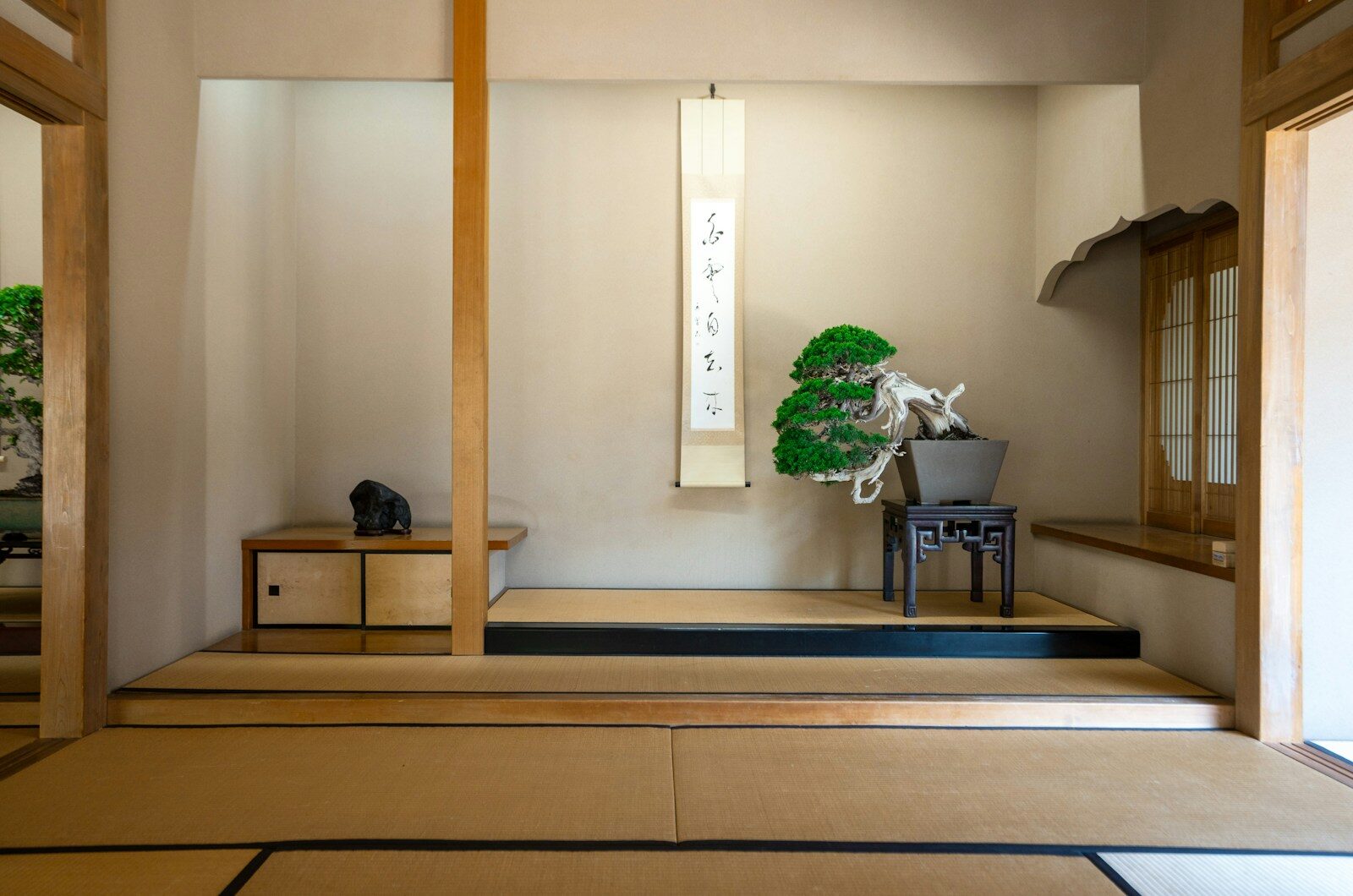
You’ve seen the photos: a sliding door opens a living room straight onto a garden, a deep wooden tub sits under a window, charred cedar siding goes almost black in the rain. The question that actually matters for a US remodel is which of that survives contact with a contractor’s quote. Some of it turns into a weekend project. Some of it turns into a five-figure custom import with no resale comp in your zip code.
| Best value upgrade | A single lime-wash or clay-plaster accent wall — texture for the price of a weekend |
| Biggest shift this year | Wet rooms (soaking tub and shower sharing one curbless zone) now in 13–16% of remodeled primary baths |
| Typical cost range | $250–$1,000 for a bidet-seat retrofit; $2,500–$7,000 to retrofit a pocket door into an existing wall |
| What to skip | A custom imported hinoki soaking tub |
| Hardest part to DIY | Widening a wall opening for a sliding door — header and structural work |
Open the Wall Before You Add a Room
A traditional Japanese house doesn’t wall off the garden — it runs a covered transition strip, an engawa, between the interior and the yard, with a sliding panel that opens the whole wall. You can’t bolt an engawa onto a 1980s colonial. What you can take is the underlying move: replace a swinging door with a wide sliding or pocket opening, and let one room’s floor read straight into the next.
Homeowners are already doing this without calling it Japanese. In Fixr’s 2025 outdoor living survey, 46% of outdoor-living professionals named pocket and multi-slide doors an emerging feature, and 56% called coherent indoor-outdoor design the year’s top trend. Houzz’s 2026 Outdoor Trends Study found exterior doors now appear in 34% of exterior renovations, up from 2024.
What Widening an Opening Actually Costs
Retrofitting a single pocket door into an existing interior wall runs $2,500 to $7,000, against $750 to $1,850 if you’re framing it into new construction, according to Angi’s 2026 pricing data. A full multi-slide glass wall — the kind that stacks three or four panels into a pocket — runs $5,000 to $20,000, or roughly $900 to $1,500 per linear foot, per HomeGuide’s 2026 figures.
Sequence matters here. If you’re widening the opening rather than swapping in a same-size door, budget $800 to $1,500 for header reinforcement before you price the door itself — an undersized header is a structural problem, not a cosmetic one, and most jurisdictions want a permit for it. If the wall you’re cutting into predates 1978, get it tested for lead paint before anyone starts demo.
The Bath as a Soaking Room, Not Just a Wash Room
In a Japanese bathroom, washing and soaking are two different acts — you rinse off, then get into a deep, hot tub to unwind, not to get clean. The US wet room has quietly absorbed that logic, even where nobody’s using the word ofuro. More than 1 in 8 upgraded bathrooms are now wet rooms — 13% — according to Houzz’s renovation research, with “better use of space” as the top reason homeowners give (66%). NKBA data cited in recent renovation guides puts the number closer to 16%, up three points year over year, with space efficiency, aesthetics, and accessibility as the drivers.
That soak comes with mechanical costs the postcard doesn’t show. Houzz’s 2025 Bathroom Trends Study found 61% of homeowners upgrade core systems — ventilation, water heating — during a bath remodel, and a deep tub is exactly where that shows up: a moisture-sensing exhaust fan and a tankless water heater aren’t optional if you want the tub full and hot without a 20-minute wait. Per the 2026 Houzz and Home Renovation Trends Study, homeowners who tackled a primary bath in 2025 spent a median of $15,000, with larger primary baths running as high as $75,000.
Cost Reality: A custom hinoki-wood soaking tub, imported and built to order, starts in the five figures before installation — and needs regular oiling to keep humidity from splitting the wood or growing mold, a maintenance cycle most US bathrooms’ HVAC wasn’t designed around. A deep, freestanding acrylic or stone-resin soaking tub gets you most of the ritual — the vertical sides, the depth, the slow hot soak — for a fraction of the price and none of the upkeep.
Materials That Carry the Whole Look
Once the layout’s settled, the material palette is what actually reads as “Japanese” in photos — and it’s also the cheapest way to test the look before committing to structural changes.
Inside, that means texture over polish: lime wash or clay plaster instead of flat paint. Limewashing interior walls costs $1.50 to $6 per square foot; a full lime or clay plaster finish runs $2.50 to $6.50 per square foot for a standard skim coat, more for a heavier decorative texture, per Angi’s 2026 cost data. Both are breathable, porous finishes — they’ll show hairline variation from panel to panel by design, which is the point, not a flaw to sand out. The same plaster that works beautifully on a living room wall needs a sealed, moisture-rated version if it’s going anywhere near the wet room described above; ask for that explicitly when you get quotes.
Outside, the equivalent move is shou sugi ban — yakisugi in Japanese — an 18th-century technique that chars cedar or pine to seal it against rot, insects, and fire without chemical treatment. Pre-charred siding runs $13 to $27 per square foot installed, averaging around $20 nationally, according to Angi’s 2026 pricing. If that’s outside the budget, metal panel siding with a charred-wood finish runs $5 to $11 per square foot for materials, per House Digest’s cost breakdown, and gets most of the visual effect without the oiling maintenance real charred wood needs every few years.
Do This First: Before charring an entire exterior, limewash one interior wall. It’s a few hundred dollars and an afternoon, and it tells you fast whether the palette works with your home’s actual light — north-facing rooms read the texture very differently than south-facing ones.
The Smart Toilet Question
The washlet — Toto’s trademarked name for a heated, self-washing toilet seat — is the one piece of Japanese design already sitting in more American bathrooms than most homeowners realize, and it’s not a trade-show novelty. The global smart toilet market was valued at $8.57 billion in 2025 and is projected to reach $9.33 billion in 2026, growing at 8.85% annually through 2031, according to Mordor Intelligence. Electronic bidet seats specifically hold 57% of the US bidet category, per market research firm DataM Intelligence.
The seat replaces your existing toilet seat — no new toilet required. It runs a warm-water wand, a heated seat, and usually a warm-air dryer, with a self-cleaning nozzle between uses. Installed cost for the seat runs $250 to $1,000, according to Angi’s 2026 data; the seat itself is $150 to $700, with the gap covering plumbing labor. Non-heated models connect to the existing water line and most homeowners can install them without a plumber. Heated models with a dryer need power, and if there’s no outlet already under the sink, adding a grounded (GFCI) one runs another $120 to $200.
What’s Not Worth It
A custom hinoki ofuro tub. Covered above, and worth repeating here: the cost is five figures before install, the maintenance is real, and it doesn’t appraise as anything other than “unusual tub” in most US markets. If the goal is the soaking ritual, a deep acrylic or resin tub delivers it without the upkeep.
Rice-paper shoji screens as your only window treatment. They’re genuinely beautiful, and they’re fragile, and they do almost nothing against UV or heat gain on a south- or west-facing wall. Paper tears, sun-fades, and doesn’t insulate — fine as a closet or pantry door accent, a poor substitute for real window coverings anywhere the sun actually hits.
Conclusion
The version of Japanese design that survives a US remodel budget isn’t the postcard — it’s a sliding door, a deep tub, and a wall that’s allowed to look handmade instead of flat. Which of those is already half-finished in your house, waiting for you to stop calling it “someday”?
Frequently Asked Questions
Is a wet room worth it for a Japanese-style bathroom?
If space is tight, yes — it’s the top reason homeowners give for choosing one, according to Houzz. Budget for the ventilation and water-heating upgrades alongside the tile; skipping those is where wet rooms fail early.
Is shou sugi ban siding worth the extra cost over regular siding?
The charring itself provides real weather, insect, and fire resistance, not just a look — but at $13 to $27 per square foot, it’s roughly double or triple standard wood siding. If the budget’s tight, a metal panel with a charred finish gets most of the appearance for less upkeep and less money.
Do smart bidet toilet seats need an electrician?
Only if there’s no outlet nearby and you want a heated seat or dryer. Cold-water, non-heated models install on the existing water line, and most homeowners can do it themselves in under an hour.
Get gorgeous projects via email
