

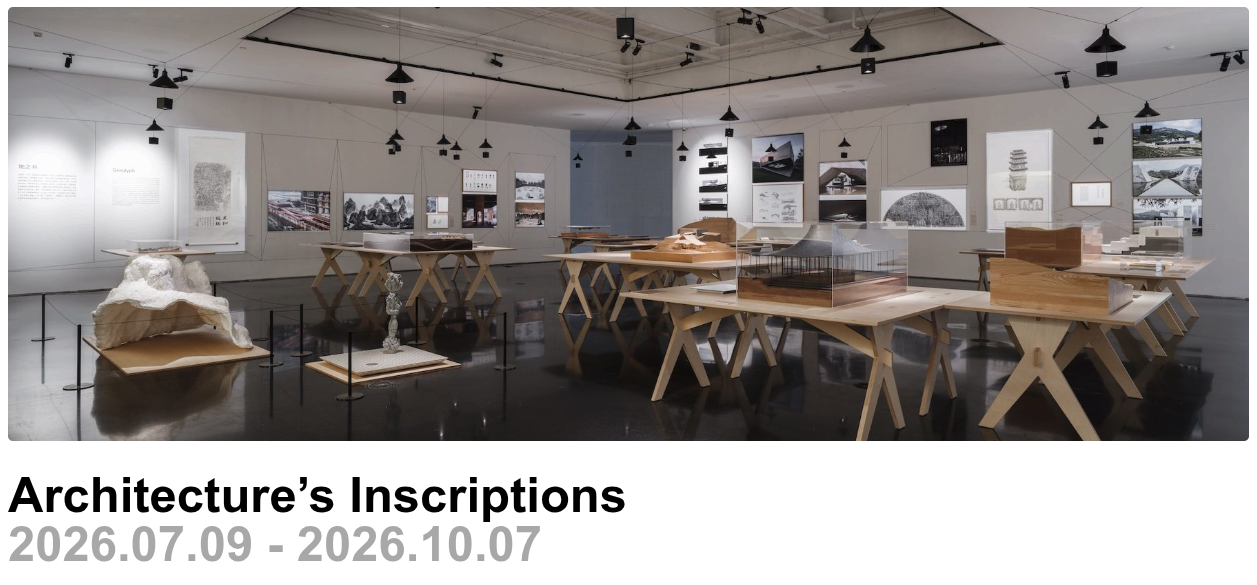
What do a Harvard theory professor, a scholar’s rock, and a decommissioned aviation fuel tank have in common? For three months this year, all of them share an address on Shanghai’s West Bund. “Architecture’s Inscriptions” runs at TANK Shanghai from July 9 through October 7, 2026, and it puts contemporary architects and artists in direct conversation with ancient Chinese manuscripts, ink rubbings, paintings, and those wonderfully strange scholar’s rocks — all inside a former industrial oil tank taller than a four-story building. It is one of the most theoretically ambitious architecture shows I’ve seen announced in Asia this year, and it’s completely worth unpacking.
| Event Name | Architecture’s Inscriptions |
| Date | Thursday, July 9 – Wednesday, October 7, 2026 |
| Location | TANK Shanghai, 2380 Longteng Avenue, Xuhui District, Shanghai, China |
| Official Website | http://tankshanghai.com/exhibition/architectures-inscriptions/ |
| Social Media | https://www.instagram.com/tankshanghai |
| Visit Info | http://tankshanghai.com/visit-contact-us/ |
| Contact Email | [email protected] |
So What Is This Show, Exactly?
The short version: it’s an exhibition about inscription — the marks, traces, and writings that come before a building ever exists as a finished idea. The curators frame it around what they call a “synthetic poetics,” which asks what happens when architecture doesn’t start with a fixed concept or a pretty representation, but instead grows out of situation, process, and repetition.
That might sound abstract, but the way the show makes its argument is refreshingly physical. Works by contemporary architects and artists are placed alongside ancient Chinese manuscripts, handscroll paintings, ink rubbings, and scholar’s rocks — the eroded stones that Chinese literati kept on their desks for meditation and inspiration. The premise draws on a long tradition in Chinese art where calligraphy and painting are treated as sister disciplines, sharing the same ink, the same brush, and the same relationship to those rocks. Inscription, in this framing, isn’t just writing; it’s any mark that persists, gets copied, and travels across genres and centuries — which turns out to be a pretty good description of how architectural ideas move too.
The Minds Behind It
This exhibition didn’t appear out of nowhere — it’s the public-facing result of years of academic groundwork. Co-curator K Michael Hays is the Eliot Noyes Professor of Architectural Theory at the Harvard Graduate School of Design, the founding editor of the journal Assemblage, and formerly the Whitney Museum’s first Adjunct Curator of Architecture. He has been researching architecture’s inscriptions since the 1990s, and in 2026 he received an Arts and Letters Award in Architecture from the American Academy of Arts and Letters. If you’ve read architectural theory at any point in the last three decades, you’ve read Hays.
His co-curator, Sun Shi Ning, holds a Doctor of Design in Architectural History and Theory from Harvard GSD and sits on the Asian Curatorial Committee at the Harvard Art Museums. Her research looks at what comes before architectural figuration — inscription, technicity, materiality, memory — which is essentially the intellectual spine of this show.
The project took shape through teaching. Hays’s colloquia at Tongji University in Shanghai examined current design practice in China, and a joint Harvard seminar led by Hays and Sun, run in collaboration with the Harvard Art Museums, had students working directly with historical objects — manuscripts, rubbings, scholar’s rocks — alongside contemporary pieces by Chinese artists such as Liu Dan, Zhan Wang, and Xu Bing, plus a class conversation on “digital shanshui” with Yang Yongliang. The Shanghai exhibition is where all of that research finally lands in a public gallery.
Fun Fact
The venue itself is an inscription of sorts. TANK Shanghai occupies five giant fuel tanks that once served Longhua Airport, one of China’s first airports, decommissioned back in 1966. The tank interiors rise more than 15 meters under industrial domes — three of them now connect as exhibition halls, and the whole complex sits in a landscape of parks, plazas, and Huangpu River views.
An Exhibition Designed by an Architect Architects Know
The exhibition design is by Yung Ho Chang, FAIA — and for an architecture crowd, that name alone is a reason to visit. Chang co-founded Atelier Feichang Jianzhu (FCJZ) in 1993, served on the Pritzker Architecture Prize jury from 2011 to 2017, headed the architecture department at MIT from 2005 to 2010, and became Dean of the Faculty of Architecture at the University of Hong Kong in 2025. His Jishou Art Museum picked up an AIA Architecture Award and ArchDaily’s China Building of the Year, both in 2020.
Handing the spatial design of a show about inscription to a practitioner of Chang’s caliber is a smart curatorial move. The exhibition’s whole argument is that traces and marks shape how we build — so the way the objects are staged inside those curved tank walls is part of the thesis, not just the packaging.
Why the West Bund Setting Matters
There’s a reason this show is happening here and not in a white-box gallery. The curators treat the West Bund itself — a riverside district layered with industrial heritage and new cultural buildings — as a live case study. The exhibition reads the district’s existing patterns of habitation as inscriptions already written into the site, and asks how they might be rewritten to support future ways of living. TANK Shanghai, a non-profit art institution built into repurposed infrastructure on the Xuhui riverfront, is basically the argument made physical.
For visiting architects and designers, that makes this a two-for-one trip: a serious theoretical exhibition inside one of the more interesting adaptive-reuse projects in China. Bring your sketchbook. And if you want to dig into the framing before you go, a press kit is available through the official exhibition page linked at the top of this article.
Quick Tips
The center is closed on Mondays, and admission to the exhibitions ends 30 minutes before closing — so don’t cut your visit too fine. Flash photography, tripods, and food and drink are not allowed in the galleries. Lockers, free Wi-Fi, portable charger rental, and wheelchair loans are available on site, and you can ask at the Visitor Services Counter about guided tours.
Frequently Asked Questions
When can I see the exhibition, and what are the opening hours?
“Architecture’s Inscriptions” runs from July 9 to October 7, 2026. TANK Shanghai opens Tuesday to Friday from 12 pm to 6 pm and on weekends from 10 am to 6 pm, with Mondays closed. Full visitor details are on the visit page linked in the overview at the top of this article.
How do I get to TANK Shanghai?
The center sits at 2380 Longteng Avenue in Shanghai’s Xuhui District, right on the Huangpu riverfront. By metro, take Line 11 to Yunjinglu Station. For anything else — group visits, accessibility questions, press inquiries — reach the team via the email listed above or by phone at +86 21 6950 0005.
Do I need a theory background to enjoy this show?
Honestly, no. The curatorial framing is dense, but the objects carry the experience: ancient manuscripts, ink rubbings, scholar’s rocks, and contemporary works, all staged inside a 15-meter-tall former fuel tank. Theory-lovers will find plenty to chew on; everyone else gets a genuinely striking encounter between old Chinese art forms and new architectural thinking.
Get gorgeous projects via email
