

Few building types get less design attention than the place where you return empty bottles. For Consignaction, the province-wide network run by the Québec Beverage Container Recycling Association (QBCRA), VAD Designers d’espaces treats the deposit-return site as public architecture rather than a back-of-store chore. Instead of one facility, the firm delivered a scalable design framework for a network expected to grow to 400 locations, built to make recycling simple, intuitive, and welcoming as Québec moves toward a circular economy.
| Project Name | Consignaction |
| Architect / Designer | VAD Designers d’espaces |
| Design Team | Andréa Veilleux (project manager), Kevin Guernon, Marie-Claude Major |
| Collaborator | rubic architecture |
| Client | Québec Beverage Container Recycling Association (QBCRA) |
| Location | Québec, Canada |
| Network | Up to 400 locations across Québec |
| Formats | Consignaction / Consignaction+ |
| Scope | Architectural concept, interior design, spatial identity and design framework |
Designing a Deposit-Return Site That Can Scale to 400 Locations
The brief held a built-in tension. Hygiene, safety, odor control, durability, vandalism resistance, and operational efficiency all had to be met, yet the sites needed to feel welcoming rather than industrial. VAD absorbed those constraints into the architecture instead of letting them define the visit, then codified the result as a framework rather than a one-off interior.
That framework runs on two formats: Consignaction for urban settings and Consignaction+ for larger, high-volume facilities, sharing one set of principles while flexing to each building. Inside, three journeys organize the plan: automated stations for big returns, individual machines for ordinary visits, and an express service where staff take pre-sorted bags. Clear sightlines (unobstructed views across a space) and streamlined circulation let visitors read the room at a glance. The specification follows the same logic, pairing Interface’s Norament rubber flooring and easy-clean Formica wall panels with custom steel by Atomic Soudure that integrates operational equipment into the architecture.
Design Decision: The neutral base palette isn't arbitrary. Its subtle tones are drawn from the materials moving through the sites (recycled glass, aluminum, and other recovered resources), so the room quietly echoes what visitors carry in, while pale wood softens a setting traditionally associated with industrial operations.
Walking Through a Consignaction Site, Zone by Zone
A Courtesy Counter Anchoring the Express Drop-Off
 Pin
 Pin
 Pin
Photo: Phil Bernard
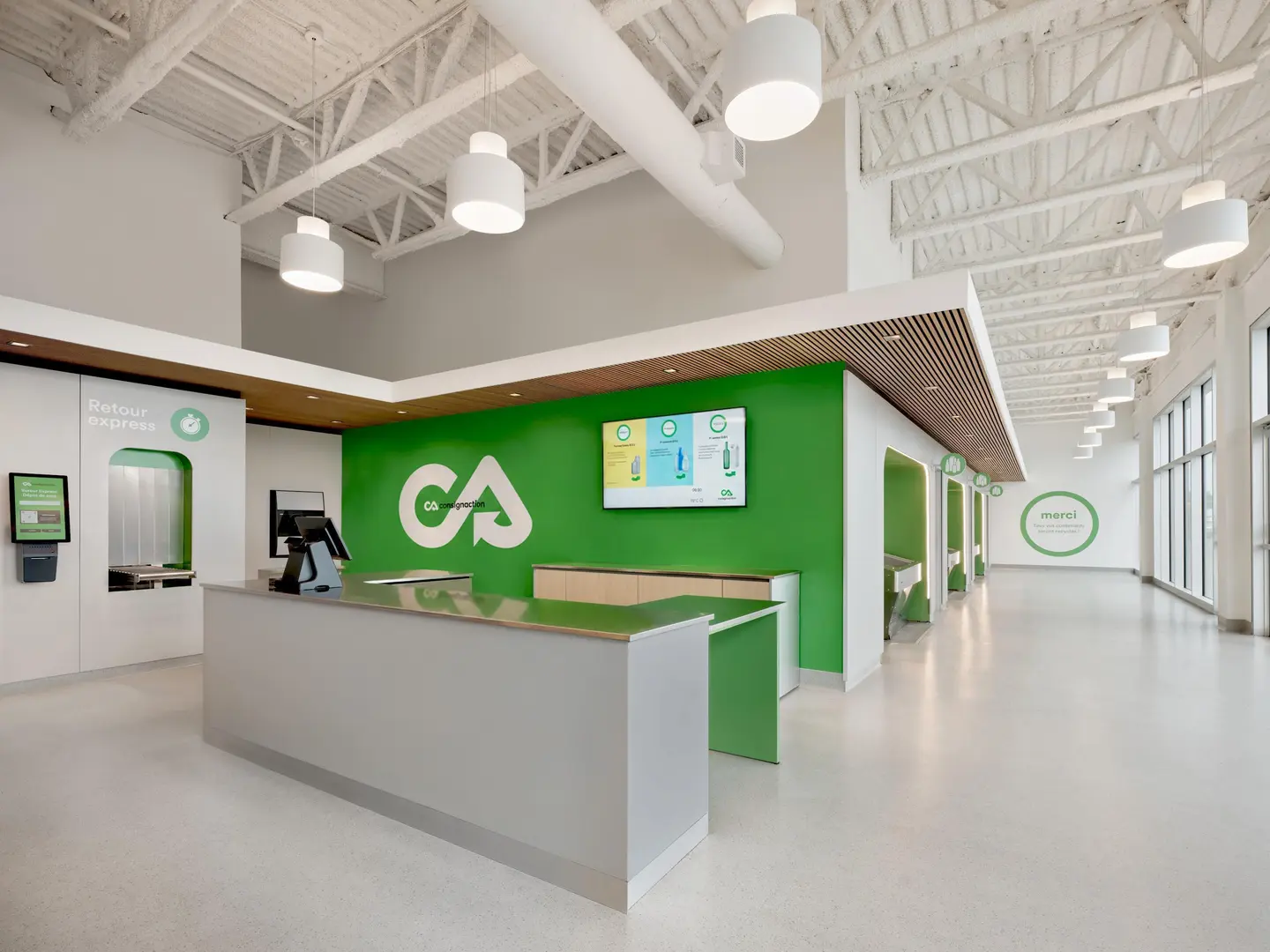
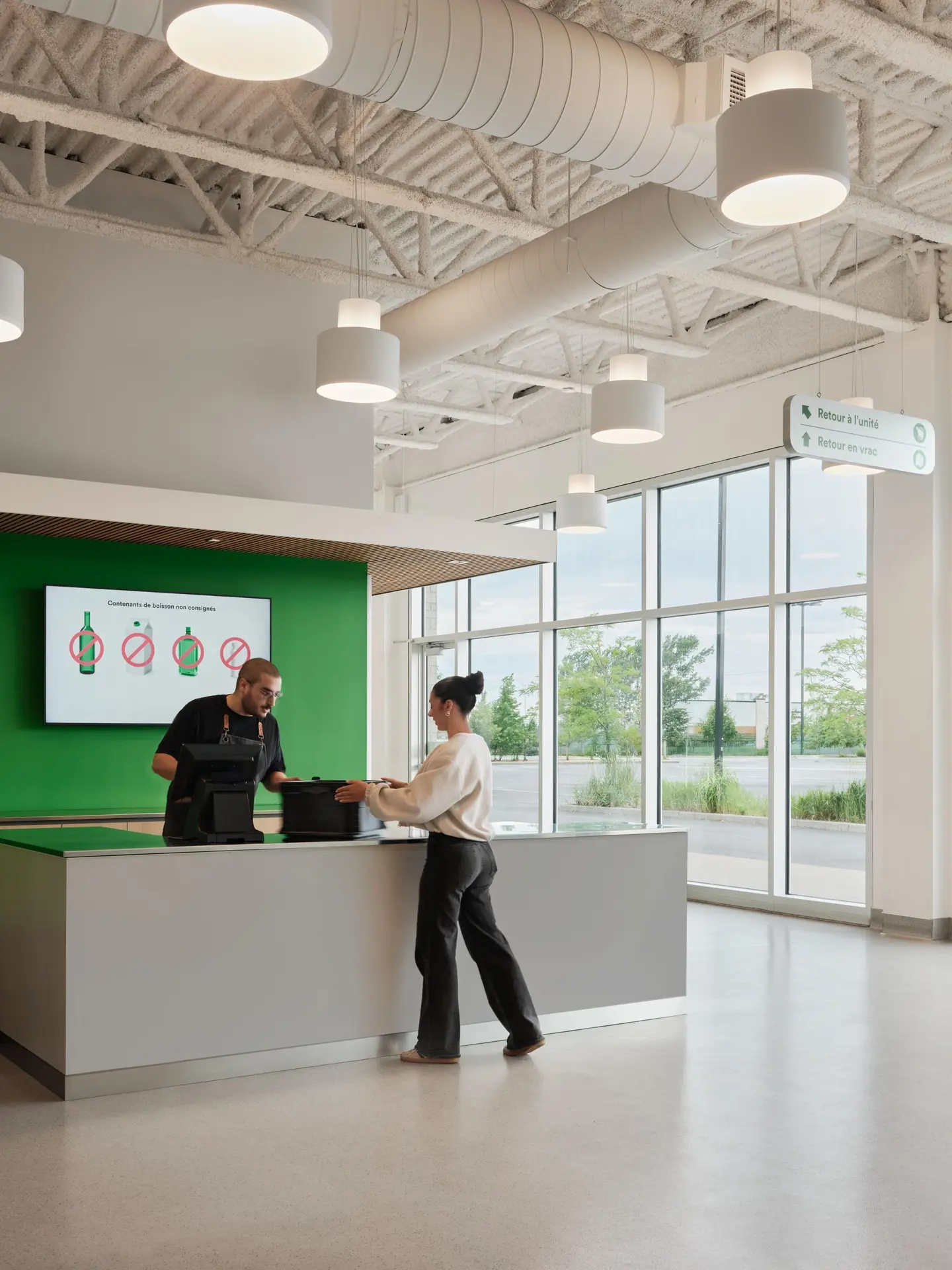
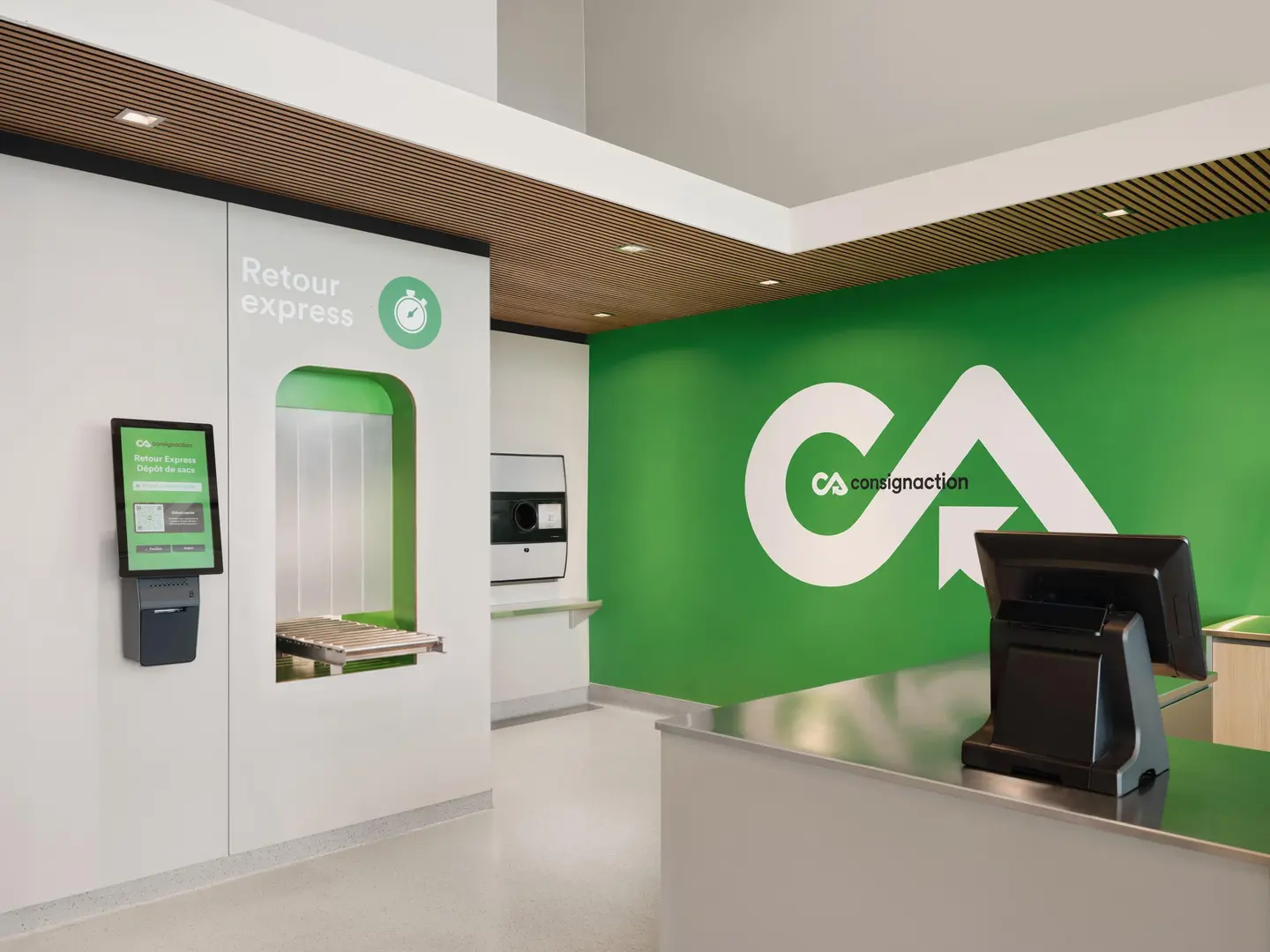
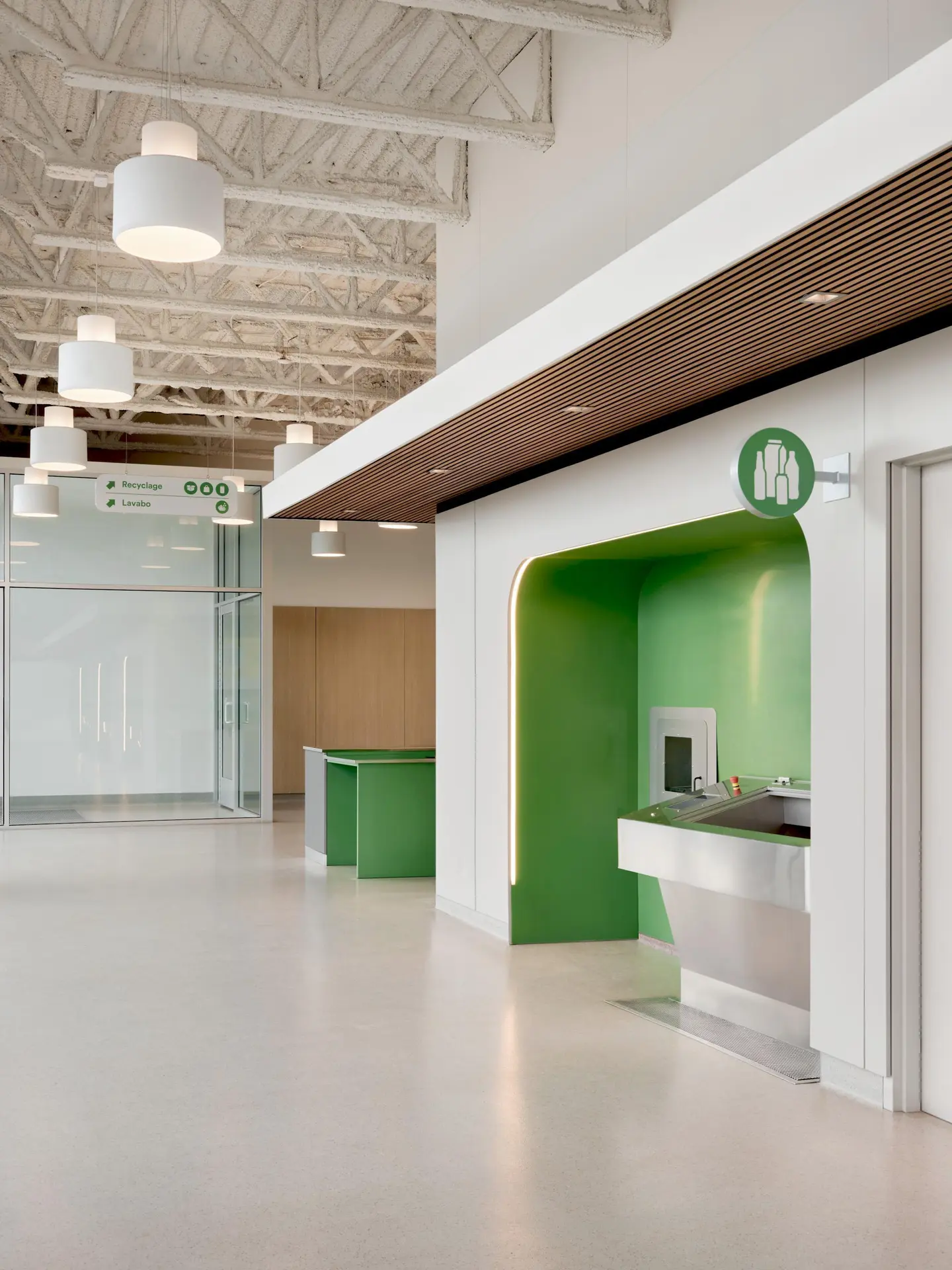
A freestanding metal-topped counter stands before a saturated green brand wall, framed by a lowered timber-slat soffit (the dropped underside of a ceiling element) that brings the scale down from the exposed, white-painted roof trusses. Beside it, the “Retour express” window lets visitors hand pre-sorted bags to staff and move on, while full-height glazing and hanging signs keep orientation simple.
Numbered Return Bays Set Into One Long White Wall
 Pin
 Pin
 Pin
Photo: Phil Bernard
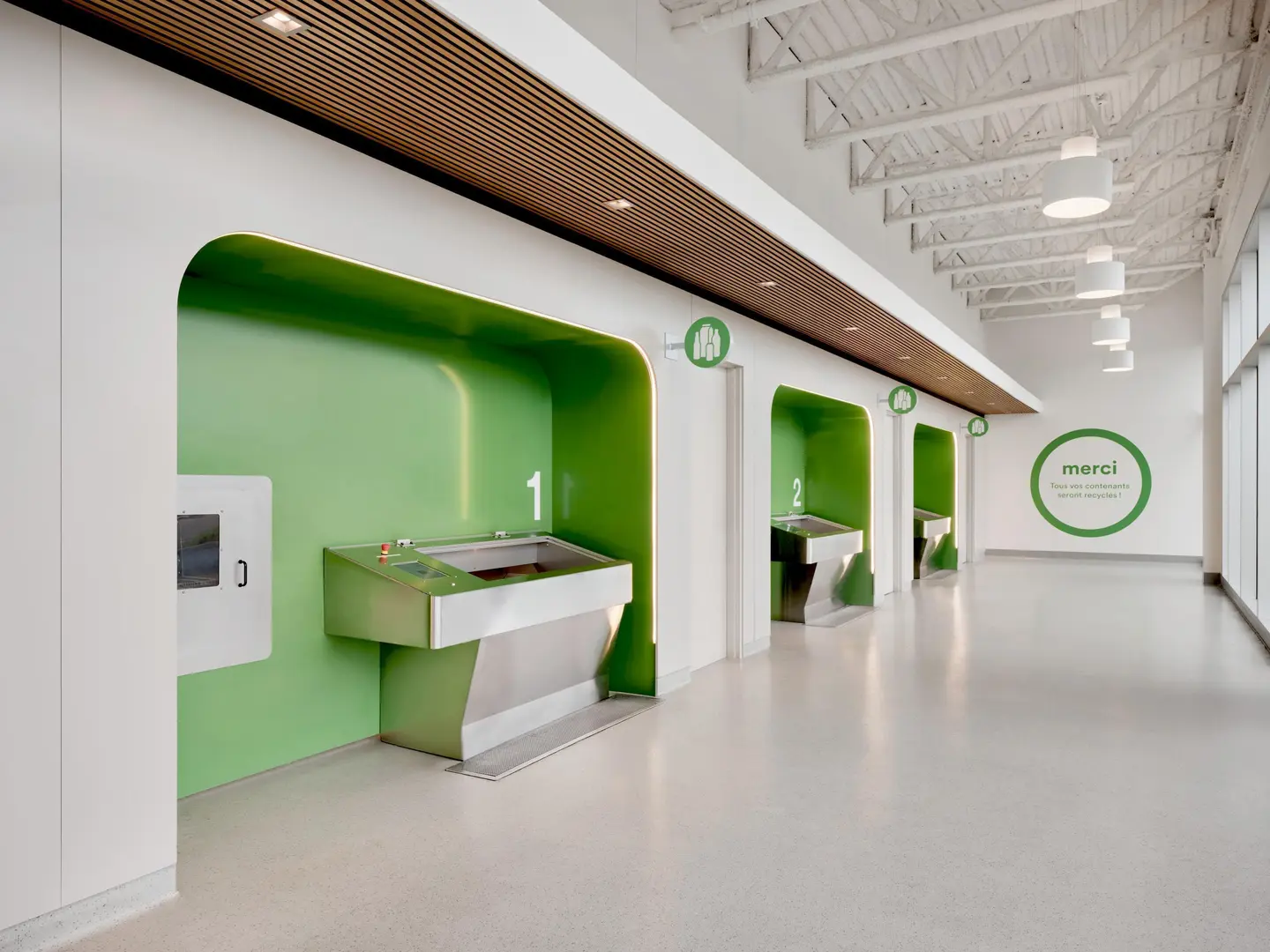
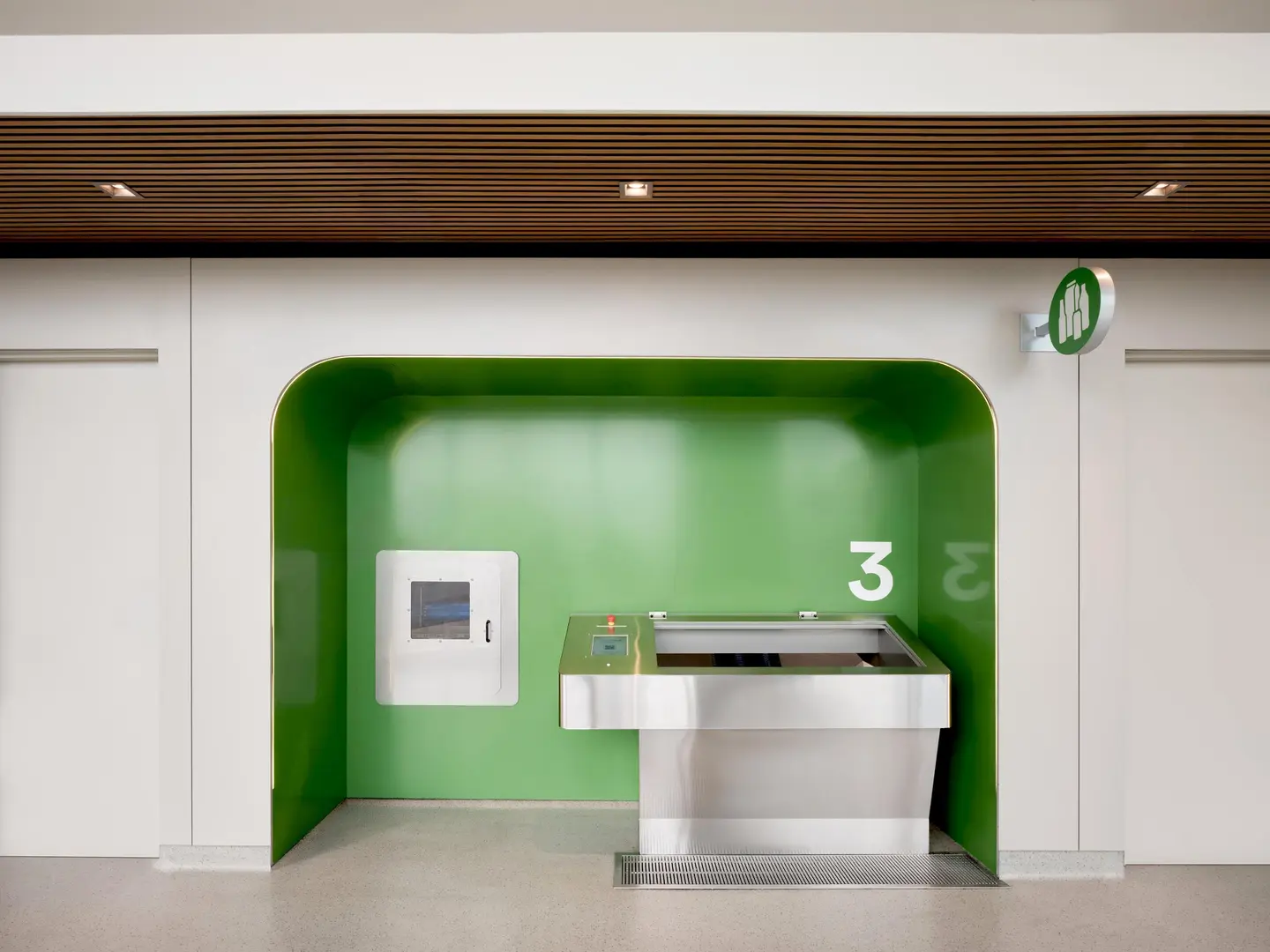
The automated return stations, intended for returns of 75 containers or more, line a single wall, each recessed into a green alcove with rounded corners, a softly lit edge, and a large painted number. Stainless-steel stations and floor grates sit inside the niches, and the continuous timber soffit above ties the run of bays into one calm elevation.
A Wood-Lined Passage for Cash-Out and Hand Washing
 Pin
Photo: Phil Bernard
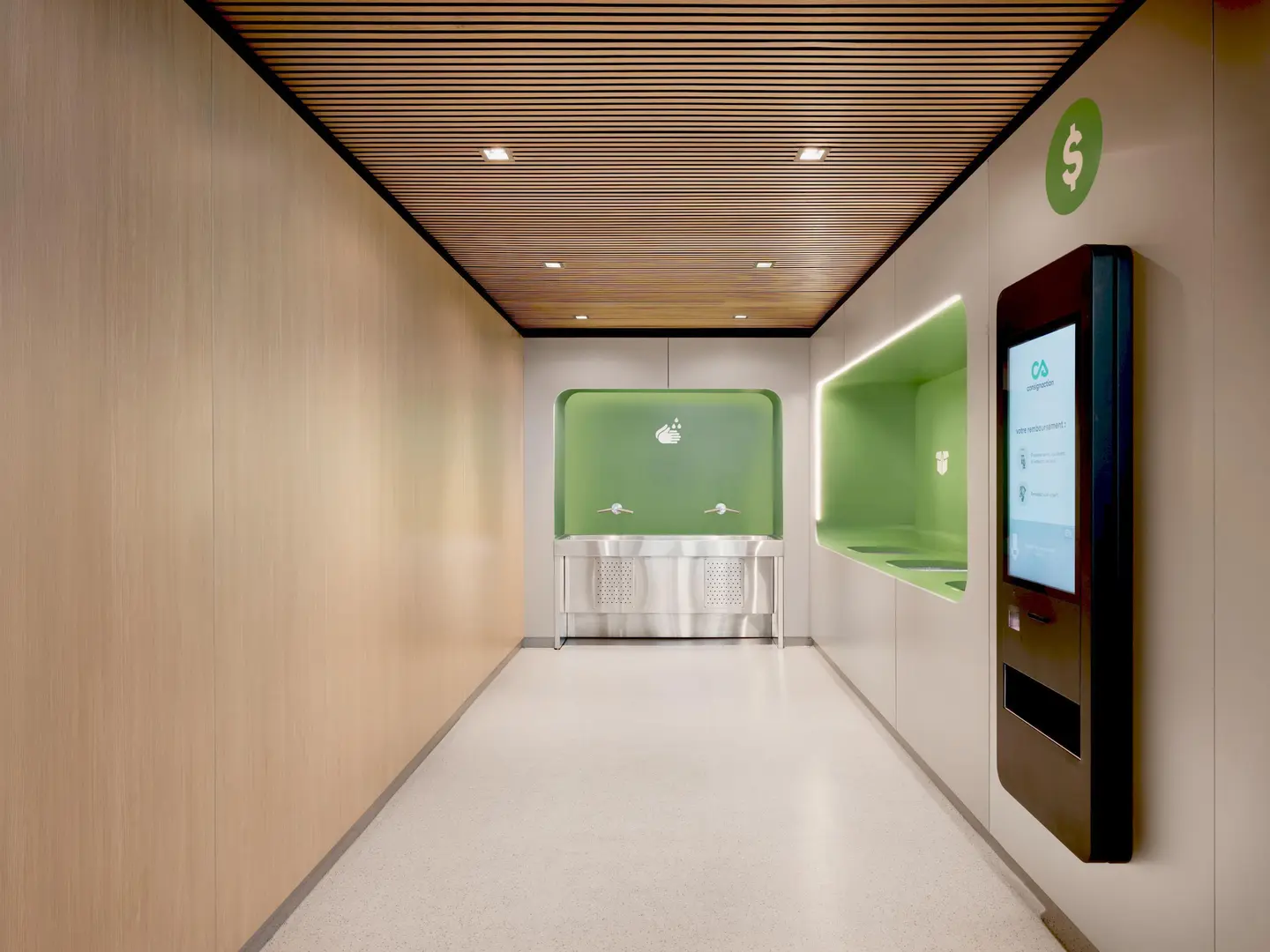
A side passage gathers the cash machine, a recycled-materials niche, and a stainless-steel hand-wash trough at its far end. Pale wood paneling along one wall and a timber-slat ceiling give this hygiene-driven zone the feel of a hallway rather than a service corridor.
 Pin
 Pin
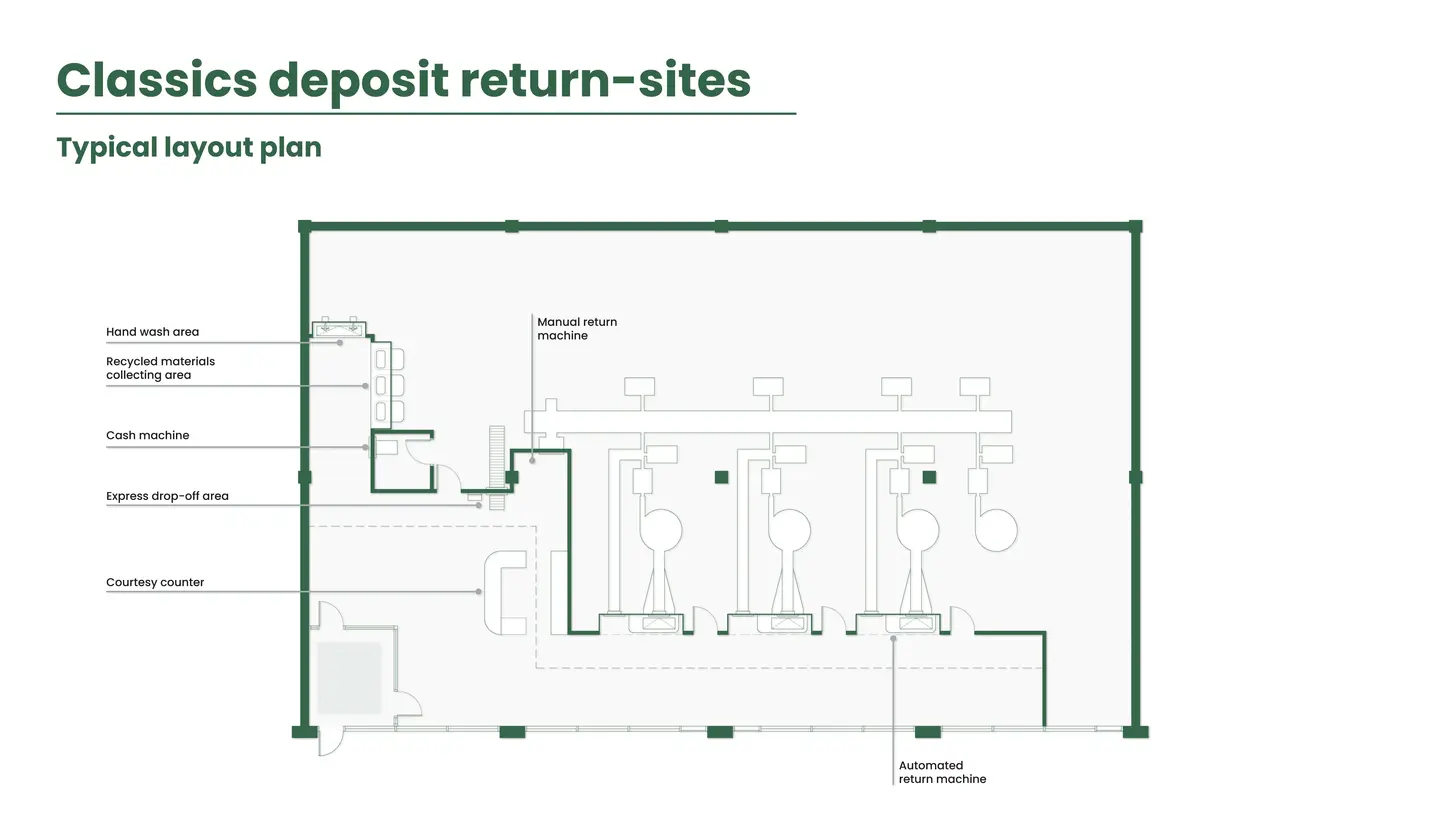
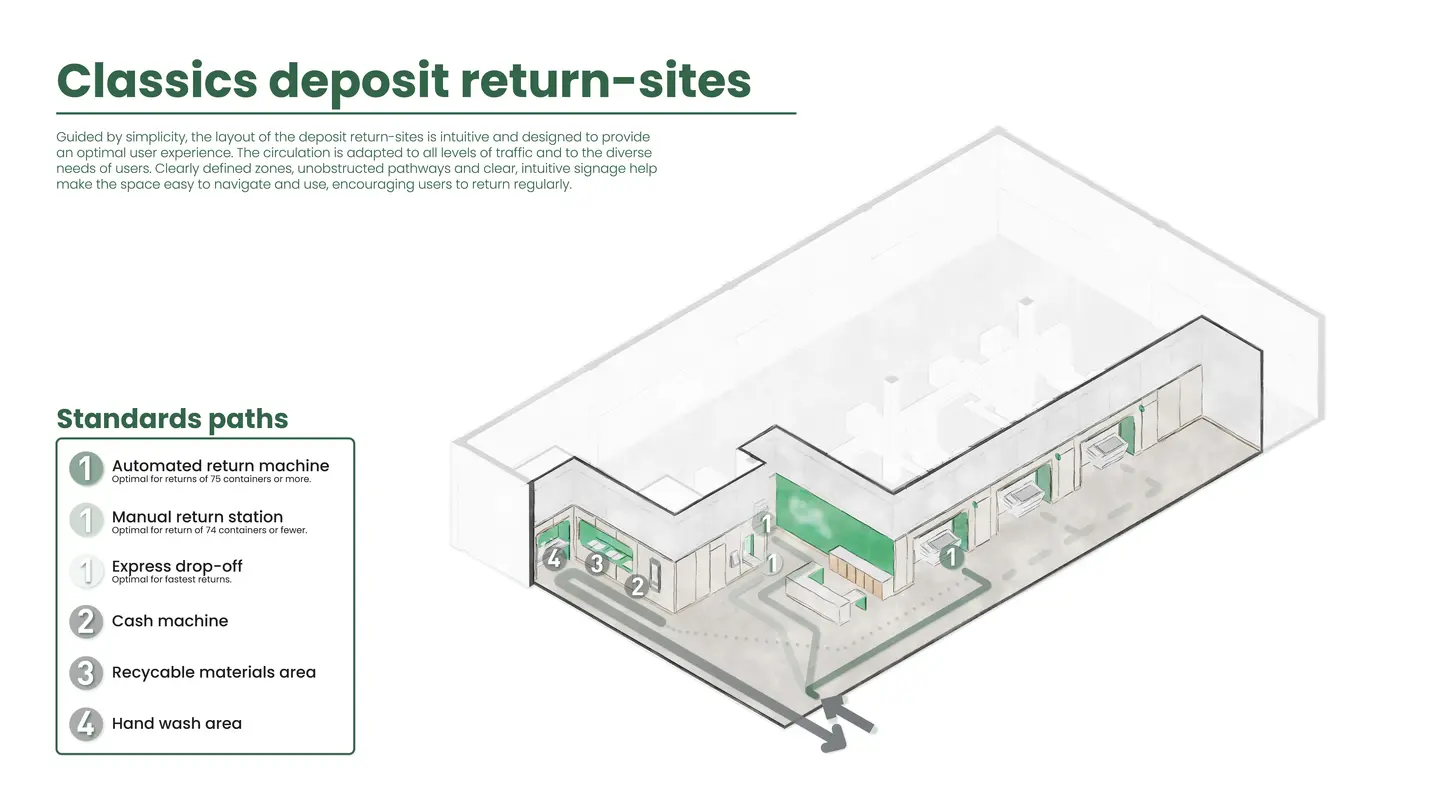
The typical layout plan and axonometric show the automated return machines lined along one wall, the courtesy counter near the entrance, and the express drop-off, cash machine, recycling, and hand-wash areas clustered in a compact side wing.
Clear Zoning, With a Few Operational Questions
Built around the size of the load
Separating automated stations for 75-plus containers, manual machines for smaller loads, and a staffed express window should spare a one-bag visitor from queuing behind a bulk return. Resilient, easy-clean surfaces sit beside pale wood and acoustic treatment, so hygiene never reads as clinical.
Where staffing and scale may intrude
The express drop-off, the fastest journey, depends on staff at the window, which could make it the hardest service to sustain at quieter sites. Repeated across up to 400 locations, one strong identity may also drift from recognizable toward repetitive.
Why Consignaction Treats Recycling as Civic Architecture
Consignaction’s real contribution is a framework rather than a single interior: a set of spatial, material, and circulation rules that lets a mundane public service feel considered wherever it lands. It suits operators of high-traffic public services working under tight operational demands, and visitors who want the errand done quickly. By making participation visible and easy, VAD Designers d’espaces shows that a bottle return deserves the same care as any public space.
FAQs
Who designed the Consignaction deposit-return sites?
VAD Designers d’espaces developed the architectural concept, interior design, spatial identity, and design framework for the Québec Beverage Container Recycling Association. Project manager Andréa Veilleux led the work with Kevin Guernon and Marie-Claude Major, collaborating with rubic architecture.
How many Consignaction locations are planned?
The network is expected to grow to as many as 400 locations across Québec. Rather than designing each site from scratch, VAD created a scalable framework that keeps the user experience and architectural language consistent while adapting to each location’s conditions.
What is the difference between Consignaction and Consignaction+?
Consignaction is the format for urban environments, while Consignaction+ is designed for larger, high-volume facilities. Both share the same design principles but stay flexible enough to respond to different building conditions and operational requirements at each site.
What materials are used inside Consignaction sites?
The palette includes Interface’s Norament rubber flooring for resilience, Formica wall panels for easy cleaning, custom steel elements fabricated by Atomic Soudure, and lighting by Eureka. Pale wood adds warmth, and products made in Québec were prioritized whenever possible.
Source: v2com
Get gorgeous projects via email
