

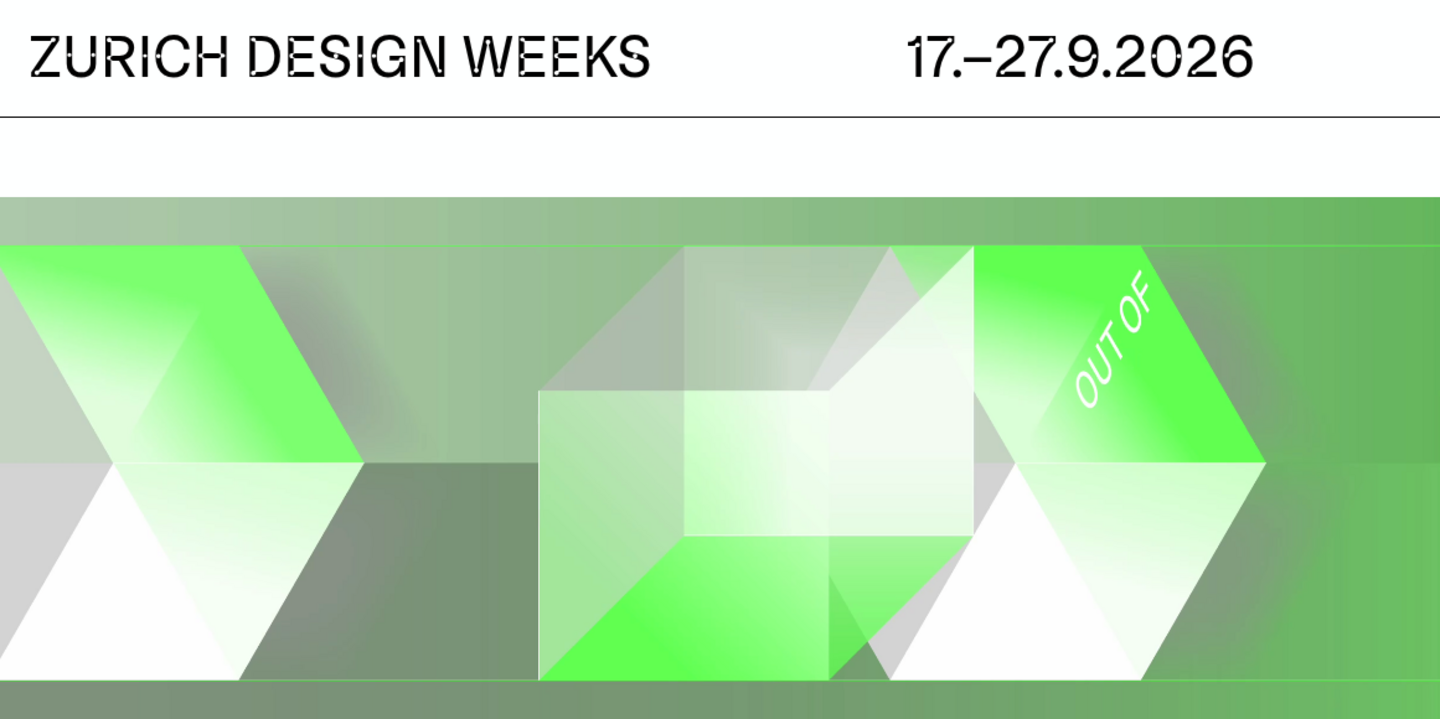
In nine days, Zurich starts sprouting neon green cubes. They will turn up outside studios in the Binz district, in shop windows downtown, on flyers and posters at tram stops, and each one is a marker telling you that something worth walking into is happening behind that door. That is the wayfinding system for Zurich Design Weeks 2026, and it may be the most literal expression of a festival theme I have run into all year.
| Event Name | Zurich Design Weeks 2026 |
| Date | Thursday, September 17 to Sunday, September 27, 2026 |
| Location | More than 40 locations across Zurich, Switzerland. Festival headquarters: Swiss Design Lounge, Museum für Gestaltung Zürich, Ausstellungsstrasse 60, 8005 Zurich |
| Official Website | https://www.designweeks.ch |
| Social Media | https://www.instagram.com/zurichdesignweeks/ |
| Visit Info | https://2026.designweeks.ch/en/program/what |
| Exhibit Info | https://designweeks.ch/register |
| Contact Email | [email protected] |
A fifth edition, and a theme that is deliberately unfinished
Zurich Design Weeks runs for the fifth time in 2026, and this year the annual theme is OUT OF…, with the ellipsis doing a lot of the work. Switzerland’s largest design event is putting the innovative power of design front and centre under that banner: an invitation to move intellectually, creatively and socially, and to trade the familiar for the untested. Festival director Gabriela Chicherio has framed the theme as spanning everything from leaving your comfort zone to new forms of collaboration to circular processes. The line that stuck with me is that curiosity, not perfection, is what takes centre stage.
That is a low bar for entry in the best possible sense. A festival that says come and see what people are trying tends to produce better rooms than one that only shows finished, photographed, press-released work.
FYI: The 2026 key visual comes from Zurich studio ALP Atelier Landolt Pfister: two slightly transparent cubes, each rotated differently so they read as several perspectives at once. It travels with the claim “Design is everywhere. We make it visible.” Those black-and-green cubes are not just graphics — they physically mark the studios, showrooms and exhibitions of programme partners across the city for the full eleven days.
Start at the Swiss Design Lounge
The Swiss Design Lounge at the Museum für Gestaltung Zürich on Ausstellungsstrasse is the festival headquarters again, and it is the sensible first stop for anyone who has not done this before. Alongside the festival Infopoint, three exhibitions run there across the full stretch: Isao Hosoe, il Trickster del Design; Design for Inclusion; and the five projects from this year’s Newcomer selection.
The whole thing opens there on Thursday, September 17, from 5:00 to 8:00 p.m. If you are still in town the following Sunday, there is an hour-long talk on Isao Hosoe at 3:00 p.m., digging into how that particular visionary thought. The museum is at Ausstellungsstrasse 60, it is wheelchair and stroller accessible, and there is a café on site — which matters more than you would think on day three of a walking festival.
House of Interiors is the new centre of gravity
The genuinely new thing this year is House of Interiors in the Binz district, which has established itself as one of the festival’s fresh hubs. If you work in interiors, this is the densest stop on the map. Iria Degen Interiors is collaborating with artist Nils Nova. Bene is opening its Zurich showroom with a programme built around the workspaces of tomorrow. Milanese gallery Nilufar is taking part for the first time, bringing a selection that mixes historic design icons with contemporary work. And Swiss manufacturer kt.COLOR is showing Blue, an exhibition devoted to ultramarine and Prussian blue pigments — two colours with more history behind them than almost anything else on a paint chart.
House of Interiors sits alongside the festival’s other partner institutions: the Museum für Gestaltung Zürich, the Landesmuseum Zürich, neue räume 26 and the Völkerkundemuseum UZH. Between them they anchor a programme that runs at more than 40 locations across the city.
The experimental end, which is usually where the good stuff is
The part of the programme I would clear an afternoon for is the younger, stranger end. Machine Arts Group is running a kiosk where objects and drawings are produced by robotic systems. Robert Wettstein is working through what can be done with the reuse of existing materials. Torro Studio is opening its doors with a run of creative workshops. Raven AI & Design Lab is hosting a participatory workshop on collective, AI-assisted creation — a subject most design festivals are still handling at arm’s length. There is also a new format called Design Knowledge, which gathers professionals and experts for talks and workshops built specifically around passing knowledge on.
Around all of that, the returning fixtures still carry a lot of the festival. The international interior design exhibition neue räume takes over Halle 550 in Zurich-Oerlikon. The Poster Safari turns public space into an exhibition surface for contemporary graphic design. And a set of design tours puts visitors in front of both newcomers and established names, which is a far more efficient way to meet the Swiss scene than wandering in cold.
The Amazing Part: Recent editions have drawn around 25,000 visitors, the programme spans more than 40 locations, and much of it is free and open to anyone who shows up. For a design festival of this scale, that combination is rare.
Why an American designer should care
Zurich is not trying to be Milan. There is no single fairground here, no badge queue, no hall map. The festival is deliberately decentralised: it sends you into institutions, off spaces, ateliers and landmark buildings scattered across a city that is small enough to cross on foot and on trams. You end up seeing Zurich itself as much as the work in it.
What that produces is a different kind of looking. Instead of scanning 400 booths for something that photographs well, you spend an afternoon in four rooms with the people who made what is in them. Add the festival’s standing emphasis on circular and sustainable design — a thread that runs through the participation criteria, not just the marketing — and you get a programme that is unusually honest about process. For anyone specifying materials in 2026, that is worth eleven days of attention, or at least the three you can realistically spare.
Frequently Asked Questions
Do I need a ticket to visit Zurich Design Weeks 2026?
Mostly, no. A large share of the programme is free and open to everyone, and the festival is designed to be walked into rather than booked into. Some individual workshops and special events do require advance registration or a ticket, so check the specific entry on the programme page linked at the top of this article before you build your day around it.
If I only have one day, where should I start?
The Swiss Design Lounge at the Museum für Gestaltung Zürich. It is the headquarters, the Infopoint is there, and three exhibitions including the Newcomer selection are on site, so you can get oriented and see real work in the same stop. From there, follow the black-and-green cubes — they mark participating studios and showrooms across the city.
Can my studio take part in a future edition?
Yes, and the process is worth understanding early. Participation runs in two stages, starting with a registration form that captures your contact details, billing address and a short project idea, followed by an upload link for the material the festival uses on the website and in its press work. Participation fees for programme partners start at CHF 1,000 plus VAT and scale up by location type and organisation size, and participants are expected to be working professionally in design, with the annual theme reflected in the project. For 2026 the window opened on March 5 and closed on April 30, so if you are aiming at the next edition, get on the organisers’ radar well before spring using the exhibit information link at the top of this article.
Get gorgeous projects via email
