

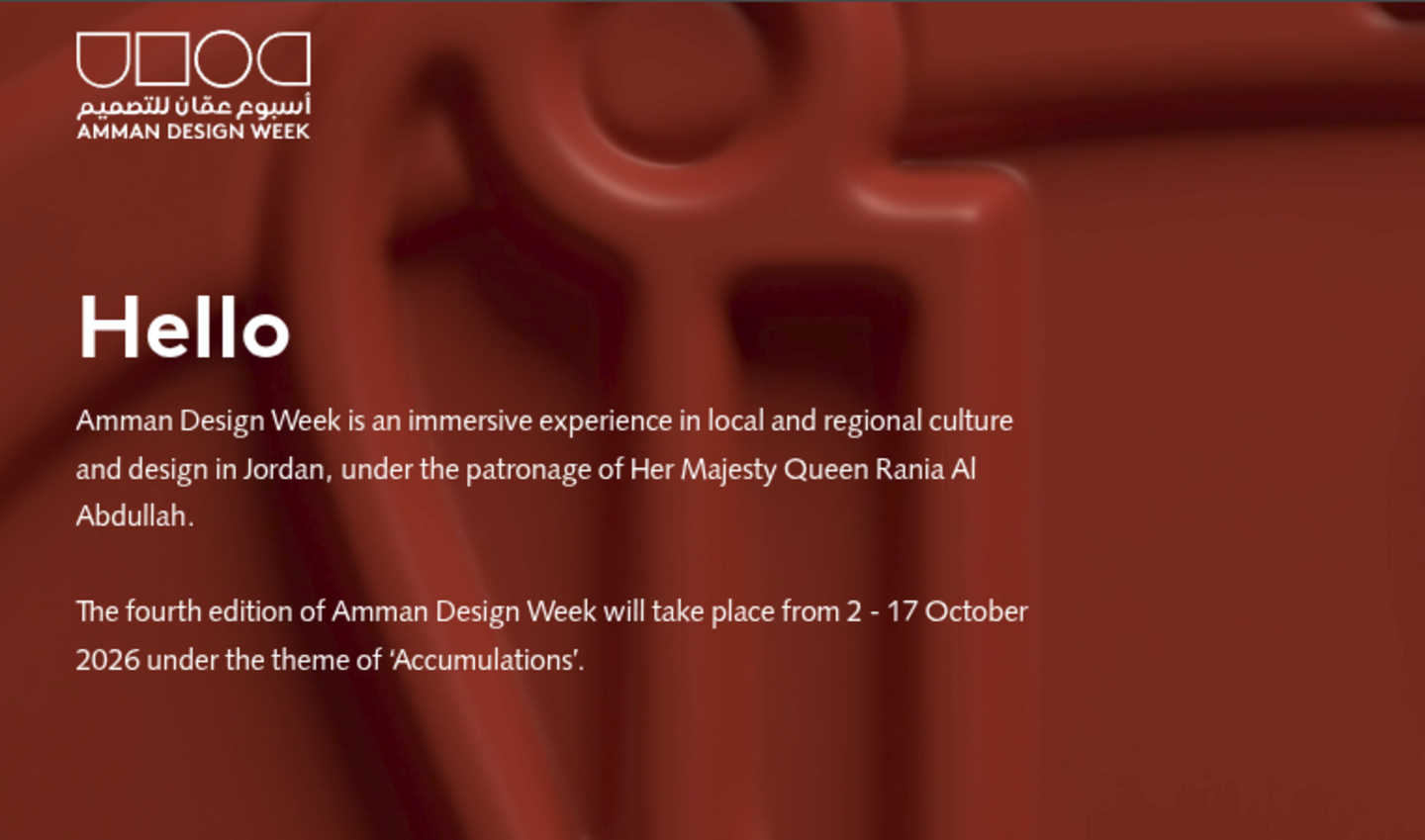
Six years is a long time to wait between design weeks. That’s how long it’s been since Amman last opened up its studios, galleries, and old stone houses to the design crowd, and this October the city finally picks up where it left off. Amman Design Week is back for its fourth edition, and the theme it picked for the comeback, Accumulations, feels like a quiet nod to everything that’s been building up in the meantime.
| Event Name | Amman Design Week 2026 |
| Date | Friday, October 2, 2026 – Saturday, October 17, 2026 |
| Location | Multiple venues across Amman, Jordan, with fringe activities in other Jordanian cities |
| Official Website | https://ammandesignweek.com/ |
| Social Media | https://www.instagram.com/ammandesignweek/ |
| Visit Info | https://ammandesignweek.com/program/all |
| Exhibit Info | https://ammandesignweek.com/faqs |
| Contact Email | [email protected] |
A Comeback Six Years in the Making
A quick bit of backstory. Amman Design Week was founded in 2016 by Her Majesty Queen Rania Al Abdullah, and it ran three editions before going quiet: 2016, 2017, and 2019, with that last one taking place from 4 to 12 October 2019. Across those editions, the organizers say the event drew 89,000 attendees, more than 160 exhibitors, and 52 participating spaces. Not bad for a city they describe as young and full of untapped stories and talent.
Those earlier editions brought local, regional, and international designers to Amman and offered free, open access to large curated exhibitions, student and community programs, workshops, talks, and city-wide cultural programming. What I find genuinely interesting is how the team frames itself: less an event, more a curatorial platform running year-round learning programs and mentorship, with the week itself being the moment all that work goes public.
Fun Fact: Amman Design Week took on the “Design Week” name on purpose, so it could plug into the global network of creative events, while keeping its focus on building a creative movement with social value.
What “Accumulations” Actually Means
Themes can be fluffy. This one isn’t. The organizers describe accumulation not as a pile of stuff, but as the slow coming-together of experience, material, and history, shaped collectively rather than by one person working alone. In Jordan, they argue, the line between tradition and innovation is porous, so accumulating is really a negotiation between past and future, scarcity and possibility, what people inherit and what they make.
They also tie it straight to the gap years. The six years since the last edition, in their telling, were years of creative energy, social dynamics, and untapped resources quietly stacking up. The theme even pushes back on the usual idea of wealth, pointing instead to human ingenuity, social cooperation, and the land itself with its layered ecologies.
For architecture and interiors people, that’s a theme about process and material rather than shiny finished objects. Dezeen’s events guide describes this year’s programme as focused on architecture, materiality, textile, and product design, with installations, talks and panels, workshops, tours, screenings, and performances.
A City-Wide Map, Not a Single Hall
Don’t picture one convention center. According to Dezeen, 50 venues are taking part across Ras El Ain, Jabal Al Lweibdeh, Jabal Amman, Iraq al Amir, and Aqaba, with most events in Amman and fringe activities in other Jordanian cities.
One venue I’m especially curious about is Darat Abu Adnan. It’s joining Amman Design Week for the first time this year, welcoming visitors into one of the few heritage homes still standing in Jabal Al Lweibdeh. For anyone who loves seeing contemporary design set against old architecture, that’s a pretty irresistible pairing.
Historically, the program has been built around a few pillars, including the Hangar Exhibition, the Crafts District, the Student Exhibition, children’s programs, city and urban interventions, workshops and talks, and a culture and food strand.
FYI: If you’re used to trade-fair booths, reset your expectations. The Hangar Exhibition is a curated show with no booth format. A curator sets the vision and decides what goes where.
Workshops Worth Watching
The lead-up programming is where things get hands-on. Francisco Regalado of LAAA (Laboratorio de Arte, Arquitectura y Arqueología) is leading an intensive two-week workshop on the studio’s approach to heritage reconstruction, blending close research, digital technologies, and experimental fabrication. For a city layered with history, that feels exactly on-theme.
There’s also Tracing Amman, an analogue photowalk and image-making workshop led by Leen Alfatafta and Lina Khalid of Darkroom Amman, together with Hannin Alnimri of makāna. And participants recently gathered at CPF Makerspace to explore the digital fabrication tools available to support their projects for this year’s edition.
The Next Generation Gets a Real Seat
This is the part that won me over. The student mentorship program received 203 applications from more than 88 universities, institutions, and high schools across Jordan. From those, 37 projects by 47 students were selected. The students will design, develop, and produce a brand-new original project that could end up exhibited at Amman Design Week 2026.
The Amazing Part: According to the official FAQ, students don’t need to be enrolled in design or architecture to apply. Any program at any Jordanian institution counts, which opens the door to some unexpected perspectives.
So if you’re heading to the region this fall, or just watching from afar, keep an eye on Amman. After six years of accumulating, it has plenty to show.
Frequently Asked Questions
Is Amman Design Week 2026 only held in Amman?
Mostly, but not entirely. Dezeen lists 50 venues across Ras El Ain, Jabal Al Lweibdeh, Jabal Amman, Iraq al Amir, and Aqaba, and notes fringe activities in other Jordanian cities. It’s worth planning your days neighborhood by neighborhood.
How can architects take part as exhibitors?
The official FAQ encourages architects to develop concepts for innovative building systems, follies, small-scale pavilions, or sections of architectural elements, since there’s no budget for fully habitable buildings. Permanent installations need the designer’s own permissions and licenses from the Greater Amman Municipality. Check the exhibit info link in the overview table for the latest details.
Is the student mentorship program only for design students?
No. Students enrolled in any program at a Jordanian high school or university can apply, including non-Jordanian students studying there. Students from institutions outside Jordan are directed to the general exhibit application instead.
Get gorgeous projects via email
