

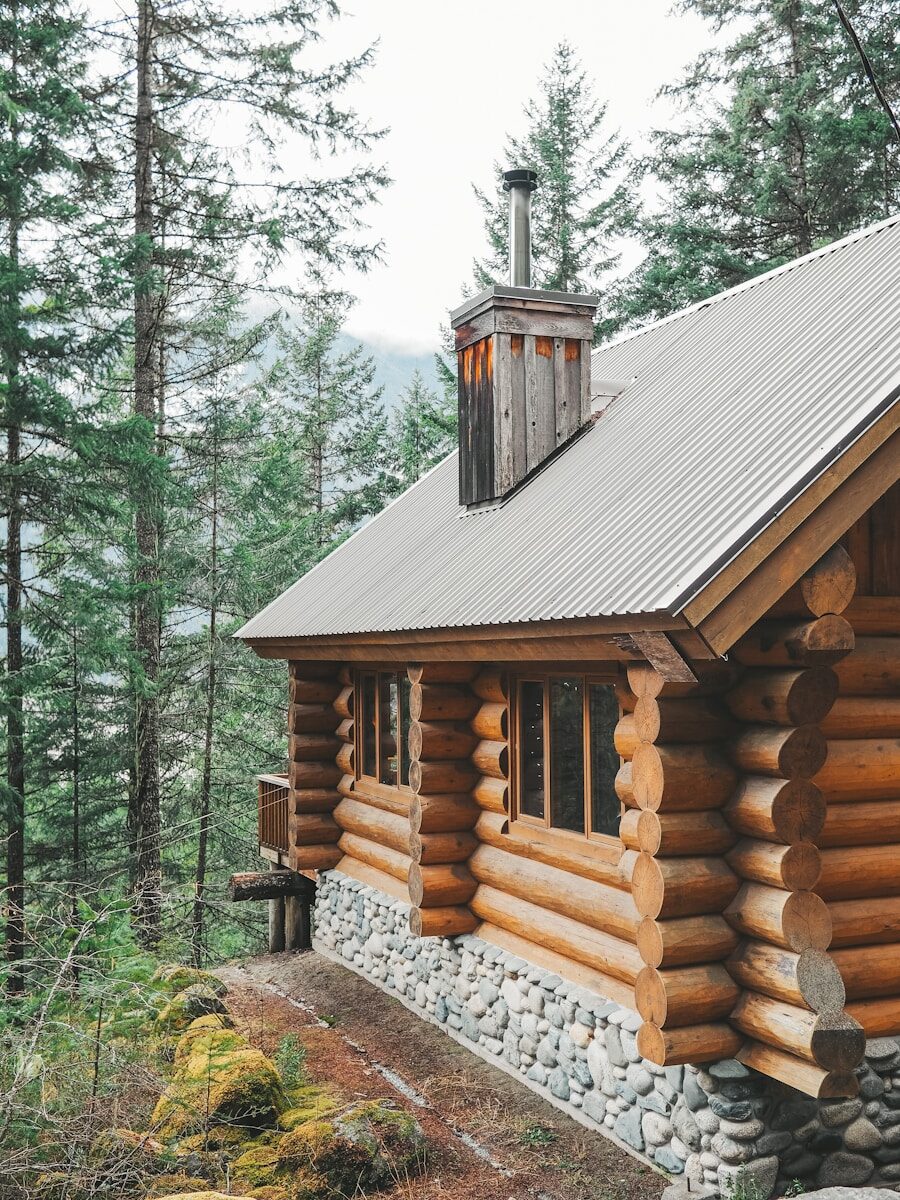
Rustic decor sells warmth and delivers it to the eye only. You can stand in a room of knotty pine and wool throws and still be cold, because cabin styling treats warmth as a color story while the heat leaves through the glass. One thing changed this year: the federal credit that took 30% off a wood stove ended on December 31, 2025. The look keeps growing regardless — rust colors were up 178% in search and chocolate brown 153% in the 2026 U.S. Houzz Emerging Summer Trends Report.
| Best value upgrade | Inside-mount cellular shades on the largest windows — 40%+ less heat loss through the glass (U.S. DOE) |
| Biggest shift this year | The 30% federal biomass stove credit ($2,000 cap) expired December 31, 2025 (HPBA) |
| Typical cost range | Interior wood paneling $2–$7 per sq ft installed; wood stove installation $1,500–$4,000 (Angi, 2026) |
| What to skip | A plug-in electric fireplace bought as heat — it tops out near 1,500 watts, about 5,100 BTU/hr |
| Hardest part to DIY | Stove venting, clearances to combustibles, and the permit — hire a certified installer |
Fix the cold surfaces before you buy more decor
1. Cover the glass, not just the walls
The Department of Energy puts heat gain and loss through windows at 25–30% of residential heating and cooling energy use, and its research on window attachments found tightly installed cellular shades cut that loss by 40% or more — around 10% off heating energy. Performance lives in the fit: specify inside mount, double-cell, AERC certification, and side tracks on big windows, because a half-inch (13 mm) gap at each edge lets room air slide down the glass and undoes most of the benefit. Then hang the linen or wool drapery you wanted over the top. The shade does the thermal work, the fabric does the cabin.
2. Put wool where you stand, not where it photographs
Wide-plank floors are the point of the look and the coldest surface in the room. A wool rug over a quarter-inch (6 mm) felt-and-rubber pad on the main traffic path — hearth to sofa, bed to door — does more than another throw blanket. Wool over jute: jute looks the part and feels like a doormat at 6 a.m. Texture is carrying warm interiors generally, with the same Houzz report showing sandstone searches up 257% and linen wallpaper up 104%.
Light changes the temperature of a room before the furnace does
3. Buy bulbs by two numbers
2700K and CRI 90 or better. Color temperature sets the warmth; the color rendering index decides whether your walnut reads walnut or gray-brown. Under a cheap 80-CRI bulb, wood grain, leather and terracotta all flatten out — a strange thing to allow in a room chosen for its materials.
Do This First — Get three light sources at three different heights into the room — table, floor, and sconce or ceiling — and put one on a dimmer. A room lit from a single ceiling point is usually what people mean by cold.
4. Warm-dim LEDs, the closest thing to firelight you can wire in
A standard LED holds its color temperature as it dims, which is why dimming a normal bulb makes a room dark rather than warm. Dim-to-warm LEDs mix red-heavy emitters with white and raise the red share as output drops, so the light warms as it lowers — the way an incandescent filament does late in the evening.
Philips Warm Glow bulbs shift from 2700K to 2200K while holding 90 CRI, in ordinary A19, BR30 and candelabra shapes for a few dollars each; architectural fixtures go further, with Cree’s Sunset Dimming modules running 2700K to 1800K and holding above 90 CRI to roughly 2170K. One catch: dim-to-warm needs a compatible dimmer, and the failure mode is flicker at the bottom of the range. Check the manufacturer’s list rather than assuming the dimmer on the wall will do.
The fire itself: what changed, and what it costs now
5. An EPA-certified insert beats the open fireplace it replaces
An open masonry fireplace pulls heated room air up the flue as it burns, and the EPA is explicit that fireplaces are not classed as wood heaters and are not EPA-certified. A certified insert is a different appliance: under the New Source Performance Standards, Step 2 took effect May 15, 2020, capping new room heaters at 2.0 grams of particulates per hour on crib wood, 2.5 g/h on cord wood. Check any model you are quoted against the EPA’s list of certified wood heaters. The Burn Wise program itself ran from 2009 to 2025 and stopped being updated on October 30, 2025, so the certification database, not the program pages, is the live reference. This is permit work in most jurisdictions and belongs to a certified installer: clearances to combustibles, hearth pad size and liner connections fail quietly, and an unpermitted install is what an insurer looks for after a fire claim.
Cost Reality — Angi’s 2026 cost data puts freestanding wood stove installation at $1,500–$4,000, labor $500–$3,000 depending on chimney condition; an insert with a new stainless liner runs higher again. What is gone is the discount: the Hearth, Patio & Barbecue Association confirms that the Energy Efficient Home Improvement Credit — 30% of purchase and installation, capped at $2,000, for units of at least 75% HHV efficiency — expired at the end of 2025. Anything installed from January 1, 2026 gets no federal credit, though some state and utility rebates continue.
6. Paneling: pick one plane and commit to it
Wood on four walls plus the ceiling is not a cabin, it is a crate. Choose the ceiling or the fireplace wall and leave the rest in a warm mineral paint. Angi’s 2026 figures put interior shiplap-style paneling at $2–$7 per square foot installed, with reclaimed stock $5–$7 per square foot above new material for the same coverage. If the house predates 1978 and you are pulling off old paneling or sanding trim, assume lead paint until a test says otherwise and follow EPA lead-safe practice.
From outside, too: that 2700K light is what reads through the windows at dusk, and it does more for the house from the driveway than most exterior fixtures.
What is not worth it
Wall-mounted electric fireplaces as a heat source. A plug-in unit on a standard 120-volt circuit maxes out near 1,500 watts, roughly 5,100 BTU per hour — enough for a small bedroom, nowhere near the vaulted great rooms they get photographed in. Buy one for the flame effect and size your real heat elsewhere.
Full reclaimed-barnwood walls. The premium over new material is real money, the boards need de-nailing and often kiln drying before they behave indoors, and the patina reads as well on one plane as on four.
Restoring an open masonry firebox as a heating move. As architecture it may be worth saving; as heat it is a net loss on a cold night, and new firebrick does not change that. An insert inside the existing opening is the version that pays.
The short version
Warmth in a rustic room is a sequence problem, not a shopping problem: seal the glass, cover the floor you walk on, fix the light, then argue about paneling. The credit that subsidized the expensive step is gone, which makes the cheap steps more interesting. So which is it in your house — is the room actually cold, or does it only look cold?
Frequently Asked Questions
Is it still worth installing a wood stove now that the tax credit has ended?
With the 30% credit gone as of January 1, 2026, a $6,000 install no longer comes back $1,800 lighter, so the case rests on fuel savings and heat during an outage. If wood is cheap where you live and you burn regularly, it still pencils out. For atmosphere a few weekends a year, it does not.
Do cellular shades really keep a room warmer, or is that marketing?
The Department of Energy figure is a 40% or greater reduction in heat loss through the window, worth roughly 10% of heating energy — but only for a tight inside mount. A loose outside-mount shade with open edges performs closer to a plain blind.
What color temperature should cabin lighting be?
2700K, with CRI 90 or higher so wood and leather hold their color. For a glow that drops toward candlelight as the evening goes on, buy dim-to-warm bulbs that shift to 2200K or lower and pair them with a dimmer the manufacturer lists as compatible.
Get gorgeous projects via email
