

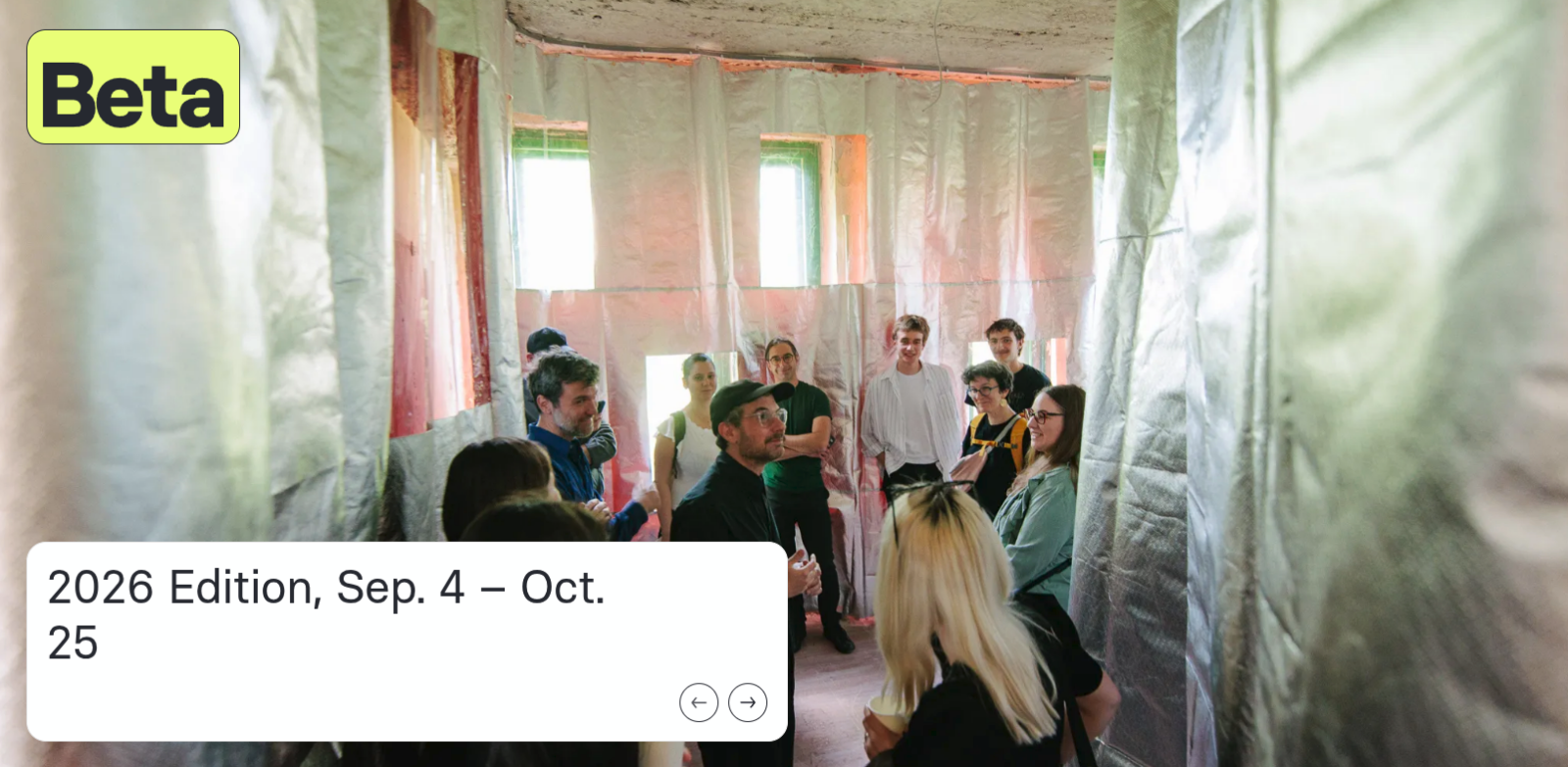
Most architecture biennials hand you a model of a building that lives somewhere else. Beta 2026 hands you a disused school and a folding chair, and asks you to watch architects argue their way through it for six weeks straight. It is an unusually literal reading of the word “practice,” and it opens in Timișoara on September 4.
| Event Name | Beta – Timișoara Architecture Biennial 2026 |
| Date | Friday, September 4 – Sunday, October 25, 2026 |
| Location | Borsec Street no. 6, next to the Botanical Park, Timișoara, Romania |
| Official Website | https://betacity.eu/en/ |
| Social Media | https://www.instagram.com/betacity.eu/ |
| Visit Info | https://betacity.eu/en/editions/2026/events/ |
| Exhibit Info | https://betacity.eu/en/beta-awards-2026/ |
| Contact Email | [email protected] |
A biennial that picks a fight with biennials
Curators Andreas Kofler and Tudor Vlăsceanu built this edition around a theme that doubles as a complaint: In Practice – as opposed to ‘in theory’. Their curatorial note argues that architecture can only enter an exhibition through proxies — drawings, models, fragments, and the people who narrate them — and that importing those proxies means running a logistics chain with real ecological, economic and human costs, often for very little effect in the place where they land. The result, they write, is a format that risks disconnecting from the realities of building, making and everyday life.
So they redirected the money. Rather than staging a temporary show, Beta 2026 puts its resources into site-specific projects that simulate, sketch, mock up, question, and might remain — either as built matter or as lessons learned. The building is not a backdrop for the exhibition; the building is the exhibition, treated as a project in progress. What the curators want to leave behind is not a finished object but an architecture in its beta stage, open to continuation — which, given the biennial’s name, is either a very good pun or a decade-long setup.
Three locations, and you can walk between all of them
Everything sits on one site at the edge of the Botanical Park, which makes this an unusually easy biennial to cover on foot.
- 1. The School — the former “Ion Mincu” Architecture High School and the main venue. Beta is upfront that it is not a monument in the classical sense, and that this is precisely why it can be intervened in directly.
- 2. The Canteen — a tall, light-filled hall next door, working as both meeting point and home of Office in Residence.
- 3. The Botanical Park — not just the route in. Installations extend outdoors, and for the first time the building can be entered from the park itself.
Fun Fact The Botanical Park dates to 1877 and was reorganised into its current form in the 1960s. It has free access and public toilets, which is more than most biennial venues can say.
Office in Residence is the reason to go
Running from September 4 to October 18 in the canteen, Office in Residence is the centrepiece and the clearest expression of the theme. Successive teams take up residence for a week each in a space that stays open to the public. The project they are working on is the building they are standing in, and each week is pinned to a different aspect of its transformation — a small syllabus for how a renovation actually gets thought through:
- Week 1 — Collectivity (Sep 4–11): Gradoscope (Sofia), Christine Cizmaș (Timișoara)
- Week 2 — Structure (Sep 11–18): SPAZIO A+A × Studio Minus (Bucharest)
- Week 3 — Envelope (Sep 18–25): SAVAȘOM (Bucharest)
- Week 4 — Materiality (Sep 25–Oct 2): Anne Marx, studio.blumenspiess & Atidh Jonas Langbein (Weimar and Munich); Stardust Architects & Andreea Tron (Bucharest, Zurich); studio dreiSt. (Vienna)
- Week 5 — Comfort (Oct 2–9): jmbad (Paris), Vokal (Helsinki)
- Week 6 — Reconnection (Oct 9–16): bouwmeester maître architecte (Brussels), Atelierul Non-Formal de Planificare Spațială (Timișoara)
With the exception of Arch+ in the opening week and the Brussels Bouwmeester Maître Architecte in the final one, every office was selected through an open call developed together with the BMA. The residency is open Wednesday to Friday from 14:00 to 20:00, and Saturday and Sunday from 10:00 to 20:00.
The Amazing Part Each phase ends with a public handover. The departing office presents its research, drawings, models and experiments, then discusses them with the incoming team in front of whoever has turned up. Traces accumulate in the space week after week, and what comes out of it feeds into the real future transformation of the school — collective authorship with actual consequences.
Opening weekend, and what the edition adds up to
Beta 2026 lists 2 curators, 2 exhibitions, 3 locations, 22 events and 61 artists. The opening weekend front-loads a good share of it.
Friday, September 4 starts at 6 p.m. at The School with an official welcome from the Beta team, the Municipality of Timișoara, partners and curators. At 7:30 p.m. the programme splits: the video installation Access All Areas premieres in the canteen — a film made with Unfold Motion about how dance and movement activate the site’s overlooked spaces — while a Dérive and Brasebine Terrisse performance runs in the Botanical Park. The opening party follows at 8 p.m.
Saturday at 6 p.m. brings the In Practice talk, where participating artists and architects work through what happens when ideas hit the realities of making, moderated by Anda Zota, editor-in-chief of igloo. Sunday is gentler: a picnic in the park at 2 p.m., then the Out in the Open conference at 4 p.m. Main exhibition hours that weekend are 19:00–22:00 on Friday and 10:00–20:00 on Saturday and Sunday.
Beta Awards and the cross-border angle
The other half of the biennial is Beta Awards, the professional pillar, and it is where Beta’s geography gets interesting. The awards cover the DKMT Euroregion, or historic Banat — a cross-border territory shared by Romania, Hungary and Serbia, named for the Danube, Criș, Mureș and Tisa rivers and reaching from Timiș and Arad into Csongrád-Csanád and Vojvodina.
Rather than functioning purely as a prize, the awards are framed as an interregional conversation about how architecture gets made in a region that shares more history than its national borders suggest. Selected projects are exhibited in public space rather than kept inside professional circles. Beta lists entries as opening in July 2026.
FYI Beta has been a member of LINA — the European network that succeeded the Future Architecture Platform — since 2020, which is where much of its international roster comes from. The 2026 edition is funded by the Romanian Order of Architects through the architecture stamp and co-financed by the Municipality of Timișoara.
Frequently Asked Questions
Is it still worth going if I can only make it in October?
Yes, and arguably more so. Office in Residence changes team and theme every week, so a late visit lands you in Comfort or Reconnection rather than Collectivity, with weeks of accumulated drawings and models already filling the canteen. Time it to a handover and you get the presentation and the debate. The residency runs to October 18; the biennial closes October 25.
How are the three venues connected?
They are effectively one site. The school and the canteen sit next to each other on Borsec Street, and the Botanical Park wraps around them — with a new entrance from the park into the building opened specifically for this edition. The park has free access and toilets, which makes it a workable base if you are there for a full day.
How would an architect actually take part?
Two routes. The Office in Residence teams were chosen through an open call developed with the Brussels Bouwmeester Maître Architecte, so that is the model to watch for future editions. For built work, Beta Awards is the entry point if your project sits in the DKMT Euroregion — and the organisers can be reached at the email listed in the overview above.
Get gorgeous projects via email
