

Most design events make you choose. Either you spend the day on an exhibition floor collecting brochures until your arms give out, or you sit in a dark room listening to people talk about buildings nobody in the room has visited. FOAID has spent more than a decade refusing to pick a side, and the 2026–27 run — New Delhi in November, Mumbai two months later — packs a trade floor, a conference, four competitions and a lighting pavilion into the same two days. It is a lot. That is sort of the point.
| Event Name | Festival of Architecture and Interior Designing (FOAID) |
| Date | New Delhi Edition: 27 and 28 November 2026 Mumbai Edition: 27 and 28 January 2027 |
| Location | NSIC Grounds, Okhla, New Delhi 110019, India Jio World Convention Centre, BKC, Mumbai 400051, India |
| Official Website | https://www.foaidindia.in/ |
| Social Media | https://www.linkedin.com/company/foaid/ |
| Visit Info | https://events.foaidindia.in/foaid-conference |
| Exhibit Info | https://www.foaidindia.in/exhibition/ |
| Contact Email | [email protected] |
Eleven years of arguing about design in public
FOAID — the Festival of Architecture and Interior Designing — launched in 2014 and is now approaching its eleventh year. It is run by Coalesce Eventz India Pvt. Ltd. and was co-founded by Shradha Badiani and Viraj Shetty, who each brought over twenty years of event-industry experience to it. Badiani handles content, curation and community; Shetty handles business development, marketing and growth. That division shows up in the programming: the curated side is unusually opinionated for an event that also has to sell booth space.
The organizers count more than seventy design shows staged across the country, over a thousand design talks, and an audience of 50,000-plus reached worldwide. Two flagship editions anchor the calendar each cycle, each running two days, each built around the same idea — display, discussion, debate, competition and awards in one place rather than four.
Fun Fact — VOX Architecture Ideas, the festival’s flagship national competition, is a free-to-enter competition. For a national platform with a jury of practitioners, theorists, researchers and academicians, that is a genuinely low barrier.
Eight programs, one campus
FOAID is structured as eight named segments rather than one undifferentiated hall. It is worth knowing which is which before you plan a day around it.
The things you walk through
- Design Arena — the main showcase, built around 200-plus projects alongside installations and product displays from architects, designers and brands.
- Light First — an international lighting pavilion covering smart lighting systems and artistic illumination, with presentations from lighting designers rather than just product tables.
- Art Arena — a curated space for artwork intended to live inside architectural projects, ranging from contemporary pieces to traditional work.
The things you sit down for
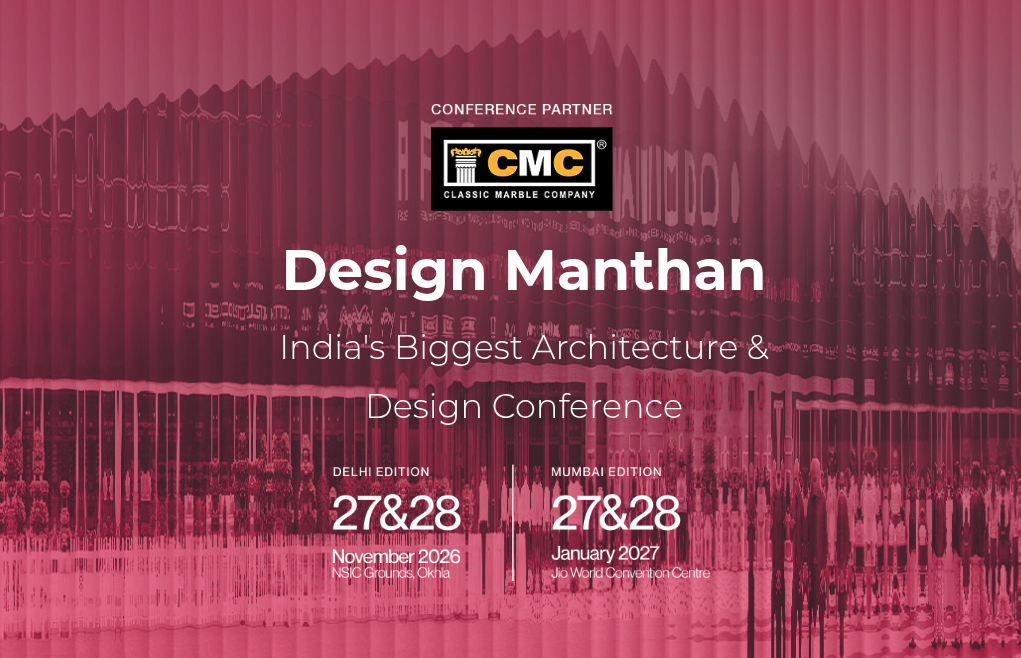
CMC Design Manthan is the conference half. The organizers put it at over 150 national and international speakers across roughly twenty sessions — panels, debates and interactive formats rather than a run of solo keynotes. Design Karyashala runs alongside it with a segment called “Uncensored — Straight from the Heart,” an open-floor exchange built specifically for architecture students, where questions go directly to established practitioners.
The Amazing Part — Most festivals bolt a student track onto the schedule and hope for the best. Design Karyashala’s Uncensored session is explicitly designed to close the verbal gap between the emerging and established generations — an unfiltered Q&A, on the record, with the people students would otherwise only read about.
The competitions
VOX Architecture Ideas
A national competition aimed at recently completed work — residential, commercial, public and institutional. Shortlisted entrants present live and face a jury Q&A, which is a meaningfully different exercise from mailing in a board and waiting.
ICA Creative Minds Next
Pitched at senior, experienced professionals, and open to ongoing and conceptual projects as well as finished ones. If you have a scheme that will never get built, this is the category that wants to see it.
Expressions
The student art-installation competition, open to architecture and interior design colleges across India. Winners are recognized at the awards ceremony, and the installations become part of what visitors walk through on the floor.
What the exhibition floor actually looks like
The exhibition is pitched at 50-plus brands and 10,000-plus architects, designers and industry professionals across the two days, organized into four experience zones: Product Arena for new material and building-tech launches, Project Displays for award-winning architectural and interior work, Art Installations for large-scale conceptual pieces, and Interactive Curated Experiences for trend labs and sensory spaces.
The patron list is a decent proxy for how the Indian specification market is currently organized. Past exhibitors include Godrej Locks & Architectural Solutions, VOX, ICA Group, Classic Marble Company, Pidilite, KONE, Asahi India Glass, Kansai Nerolac, Jaipur Rugs, Aquant and UniAcoustic — a mix of global manufacturers, Indian category leaders and craft-scale studios sharing the same floor. Organizers also run a Brand Meet program that lets visitors book one-on-one sessions with exhibiting brands rather than gambling on catching someone free at a booth.
FYI — FOAID also runs Build India Vision, a forum on infrastructure and the future of cities that brings planners, engineers and urbanists into a program that is otherwise dominated by buildings and interiors. If your interest sits at the urban scale rather than the room scale, that is the thread to follow.
Two cities, two very different rooms
The New Delhi edition takes over NSIC Grounds in Okhla on 27 and 28 November 2026 — an open exhibition campus in the city’s industrial estate, which suits large installations and heavy material displays. The Mumbai edition follows on 27 and 28 January 2027 at the Jio World Convention Centre in Bandra Kurla Complex, a considerably more polished indoor venue in the middle of Mumbai’s business district.
The two-month gap between them is useful if you are exhibiting: it gives a brand two distinct regional audiences in a single season without splitting a marketing budget across unrelated events. If you are attending, the practical calculation is simpler — pick the one you can reach, because the format carries across both.
Frequently Asked Questions
I can only make one edition. Does it matter which?
Not structurally. Both editions run the same two-day festival format across the same eight segments, so the decision is really about geography and calendar — New Delhi at the end of November 2026, Mumbai at the end of January 2027. The venues differ in character, and the regional audience and exhibitor mix will shift between the two, but you are not choosing between a major edition and a minor one.
Is FOAID open to students, or is it a professionals-only event?
Students are actively programmed for. Expressions is a competition built specifically for students of architecture and interior design colleges in India, and Design Karyashala’s Uncensored segment exists to put students in direct conversation with established architects. Both sit inside the main festival rather than off to one side.
How does a brand get onto the exhibition floor?
Through the exhibition and sponsorship route — the exhibit info link at the top of this article covers booth participation, and the organizers handle pricing and floor allocation directly. You can also reach the team at the email listed in the overview above for exhibitor, speaker or media-partnership inquiries.
Get gorgeous projects via email
