

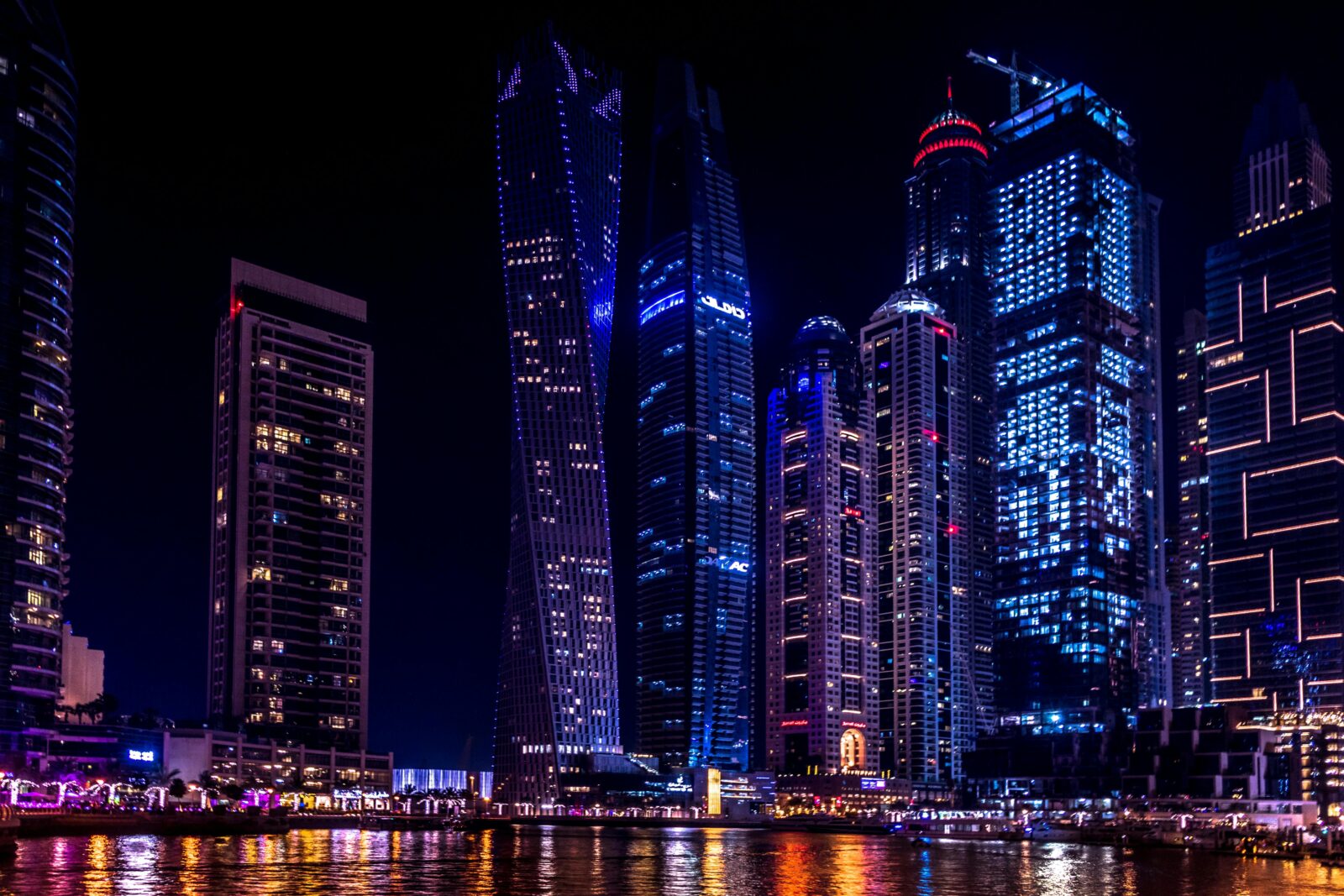
Walk through the UAE, and it quickly becomes clear: the architecture there performs. Not merely structural feats, these buildings stand as curated experiences that bridge geometry and imagination. Some make you question physics. Others make you question whether you’re still on Earth.
This isn’t just about tall buildings. It’s about buildings that say something. Every twist in the skyline, every shadow cast on the desert sand, every reflective panel is part of a deeper narrative. It’s not architecture or art. It’s both.
In fact, he value of UAE architecture is on the rise and its growth is tied to the expanding construction market, which is projected to grow from its 2024 value of approximately $107.2 billion to $130.8 billion by 2029.
A Tower That Breathes Nature: Leaf Tower, Abu Dhabi
Some buildings are shaped by ambition. Leaf Tower is shaped by nature.
Hidden in the urban matrix of Abu Dhabi, this tower doesn’t scream for attention. It invites it, slowly. Inspired by the form of a leaf, the structure reveals a dual-tower concept nestled inside a singular biomorphic envelope. That envelope is both for the sake of aesthetics and for function. It shields. It regulates. It speaks to sustainability while performing like a sculpture.
But this isn’t a metaphor for metaphor’s sake. The “Leaf” shape isn’t symbolic decoration. It houses within it a dual-core tower system, blending residential and commercial units without visible division. It gives the sense that you’re in a living, breathing structure; one that adapts, shelters, and reflects.
There’s a reason architects and developers are paying close attention. This isn’t a standard tower. It’s a living thesis on how design can echo biology. A structure that nods at the natural world without pretending to be part of it. Leaf Tower is the UAE’s quiet declaration that art and engineering can grow from the same stem.
When Form Challenges Function: The Opus by Zaha Hadid
Now shift your gaze to Dubai. One building doesn’t quite behave like the others. That’s the point.
The Opus by Zaha Hadid is more absence than presence. At its heart, the building is known for what’s not there. A cube pierced by an amorphous void. A gaping, fluid hole that seems to have melted its way through solid geometry. Some see chaos. Others see poetry.
Inside, it works as a hotel and office space, but its true purpose is spectacle. Zaha Hadid’s only project in Dubai, the Opus is an example of mathematical rebellion. Everything curves where it should cut. Everything glows when it should shadow.
Hadid’s fingerprints are in every detail. She once said her goal was to create buildings that defy logic while still obeying it. The Opus does just that. It bends perception without losing structural integrity. It lets the void be the feature.
The Museum of the Future: When Buildings Tell the Story
In another city, a museum might house the future. In Dubai, it is the future.
The Museum of the Future is not a conventional structure. Its toroidal shape, often compared to a hollow silver eye, doesn’t rely on traditional pillars or internal columns. Instead, it floats. That’s not an illusion. That’s parametric design and algorithmic modeling executed with precision.
The Arabic calligraphy cut into the façade is not decorative filler. It’s poetry from UAE’s Vice President. The words wrap the building like code wraps software. In fact, the design process wasn’t unlike coding. The building’s structural skin was generated digitally, then physically realized through robotics and 3D modeling.
Here’s what makes this more than a museum: it doesn’t just house exhibits about tomorrow. It’s already operating with the tools of tomorrow. Smart materials. AI-integrated environmental systems. Modular construction.
Real Estate or Canvas? Cayan Tower’s Twisting Statement
In a skyline packed with vertical assertiveness, the Cayan Tower stands out by rotating away from the pack.
Located in Dubai Marina, this 90-degree twisting tower doesn’t just look different. It feels different. The twist isn’t cosmetic. Each floor is rotated a few degrees to reduce wind load and increase views. The result? A design that reshapes conventional high-rise thinking.
What makes Cayan truly unique is not just the rotation but the restraint. This isn’t flamboyance. It’s discipline. A subtle gesture that uses advanced engineering to create serenity out of a spiral.
The effect is hypnotic. You could stand at the base and watch it curl into the sky, like smoke frozen in time. It’s a building that proves you don’t have to shout to be iconic.
The Louvre Abu Dhabi: Light, Water, and Silence
Sometimes, the most powerful architectural experiences come not from size or complexity, but from stillness.
The Louvre Abu Dhabi is less a museum and more a landscape. Designed by Jean Nouvel, the structure floats on water. Not metaphorically. Physically. The effect? Visitors feel like they’re approaching an island of thought. A place where art and sea collide.
Its signature feature is a massive, domed roof perforated with star-shaped patterns that creates a “rain of light” effect. As the sun shifts, so does the mood of the space below. This isn’t light as utility. It’s light as a paintbrush.
Inside, galleries flow like open-air streets. There’s no clear start or end. Just a journey. One that erases boundaries between civilizations, between exhibits, and yes, between architecture and art.
Real-world example: one visitor described how the play of light and shadow under the dome brought them to tears. Not because of the exhibit, but because of the architecture itself. That’s the moment the building became more than a shelter. It became a story.
Get gorgeous projects via email
